Before a single word of introduction was spoken at the Wilderness Awareness School’s Wild Women’s Weekend last October, the event’s host handed off a hypothetical torch to Marina Rivera, who stepped forward to ignite the ceremonial fire that would officially open the gathering.
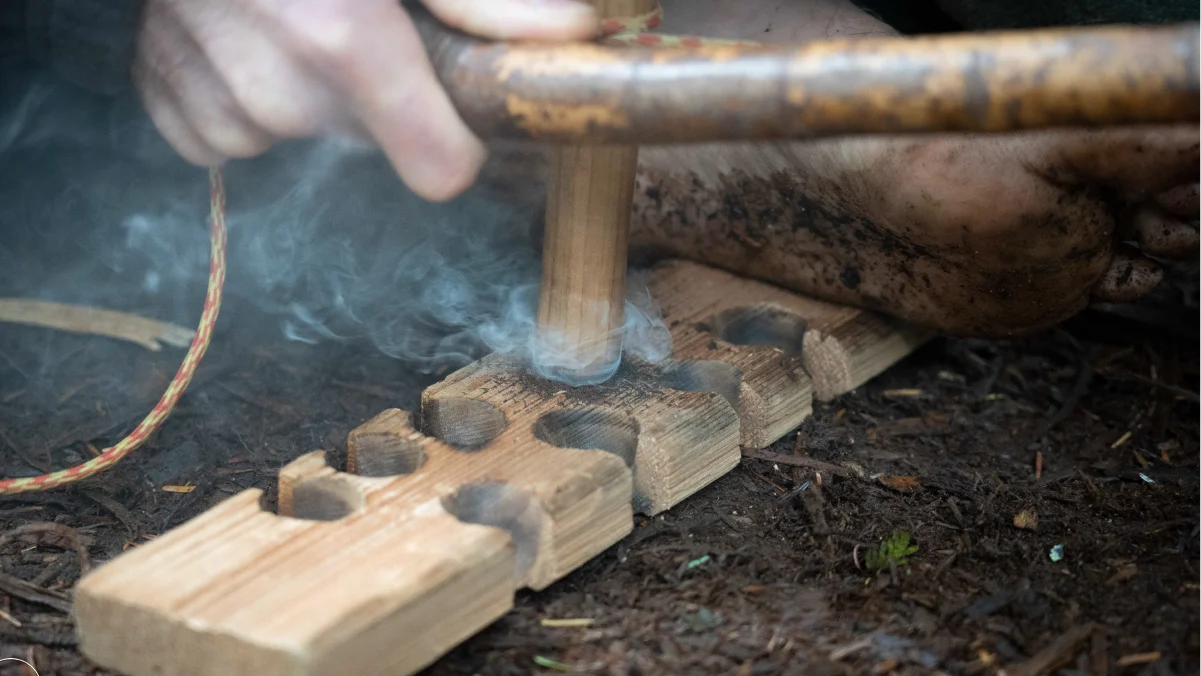
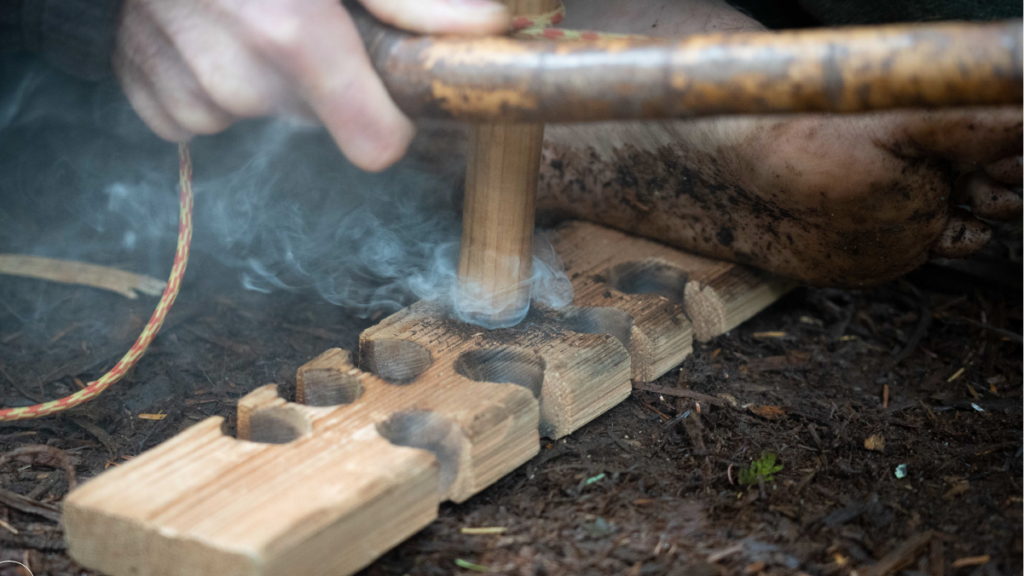
Moving in slow, deliberate, dancer-like steps, Marina approached a piece of wood held steady by her bare foot. She paused to take several large, steady breaths, closing her eyes to center herself. When she opened them, the process began. Using one hand, she held a wooden spindle, pressing its tip into a board on the ground. With her other hand, she grasped a handmade bow, sawing it smoothly back and forth. The motion caused rapid friction between the rotating spindle and the hearth board below.
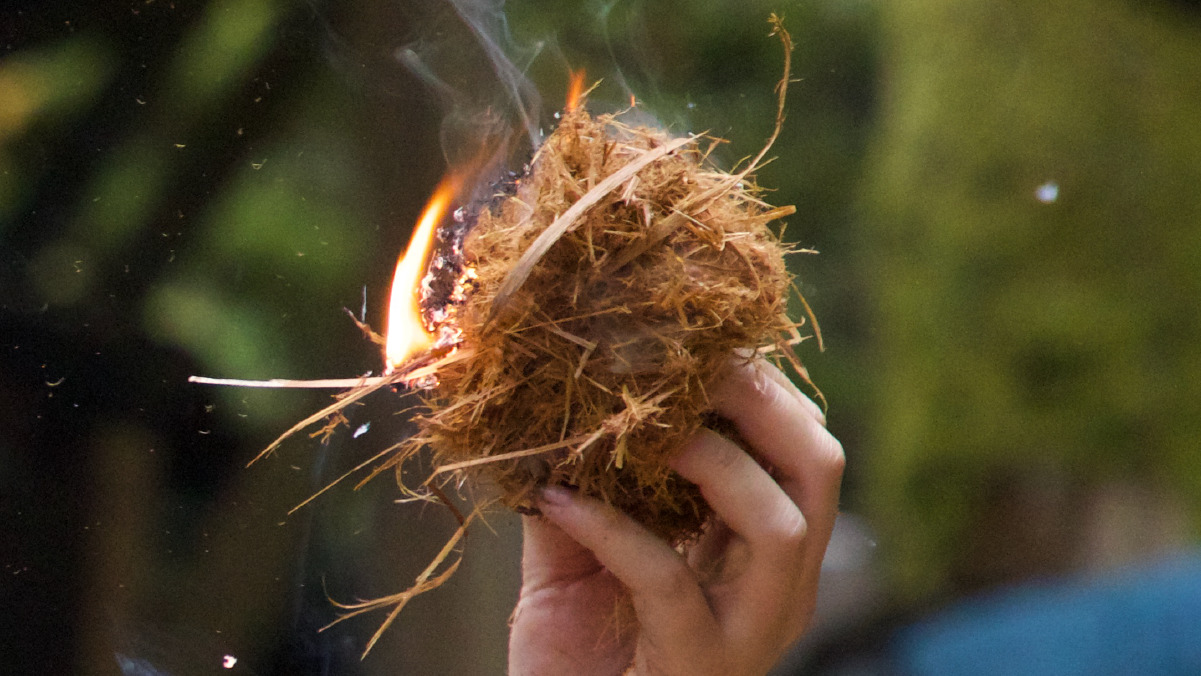
Every few moments, she paused to take intentional breaths. Within a short time, thin wisps of smoke began to rise from the dark friction point, signaling the birth of a glowing coal. Carefully lifting the coal, she nestled it inside a soft tuft of shredded cedar tree bark. Kneeling close, Marina blew gentle, measured breaths into the bark until soft flames licked upward. She then transferred the nascent fire to a intricately carved feather stick—a piece of wood featuring thin, curled shavings coalescing at its tip—before finally moving the flame to a small pile of tinder waiting in the central fire pit.
And just like that, there was fire. It burned brightly for only a brief moment before Marina extinguished it, as a seasonal burn ban was firmly in place.
Throughout the entire ceremony, attendees found themselves utterly transfixed. Aside from the sound of Marina’s controlled breathing and the eventual crackle of the wood, the surrounding forest was quiet. Roughly 50 participants watched with rapt attention. While many of the onlookers, including author and researcher Elizabeth Doerr, were initially unfamiliar with the technical names of the tools being used, it was immediately clear that the demonstration transcended basic survival mechanics. It felt, undeniably, somewhat spiritual.
Even acknowledging that spiritual element can feel slightly uncomfortable, particularly for those navigating a modern, back-to-the-land journey. Yet, watching Marina conjure fire from raw elements while seemingly tuning out the gaze of over a hundred watching eyes sparked a deeper realization. Crafting fire was not merely a mechanical, hard skill; it was anchored in something softer, something rooted deeply in intuition and emotional presence.
That observation was reinforced later when participants broke into smaller workshop groups. Marina led the fire-making session, introducing the group to the essential tools of primitive friction firecraft: the bow drill, cedar bark, feather sticks, and kindling. Excitement rippled through the group at the prospect of finally learning how to harness fire from the raw materials scattered across the surrounding landscape.
Then came a perspective-shifting piece of advice from the instructor. Marina explained that while carrying modern fire-starting tools—what she lightheartedly referred to as nature’s blowtorch—can be useful, relying on them entirely is often a direct compensation for a lack of genuine understanding of one’s natural environment. As a person truly gets to know the land, those artificial crutches become unnecessary, though learning that level of deep ecological literacy takes far longer than a brief afternoon workshop.
For participants balancing busy modern lives, becoming a master of the local ecology overnight was unrealistic, but the underlying philosophy proved magnetic.
Following a thorough briefing on safety rules—essential when handling sharp knives and hatchets—Marina demonstrated the foundational steps of the craft. She walked the group through wood-chopping, fuel gathering, feather stick production, and fire lighting using a ferrocerium rod and knife. Watching her work highlighted the immense amount of preparation required long before a single spark is ever struck. Furthermore, Marina deliberately used the phrase "getting fire" rather than "making fire."
When asked about the distinction, she explained that drawing fire requires technical proficiency combined with emotional attunement. In her view, fire is fundamentally ingrained in human biology and history, serving not only as a physical center for community but as a reflection of human identity itself.
The concept of "getting fire" implies that fire already exists within the materials and the environment; the human role is simply to become open and receptive to it. Watching Marina’s graceful opening ceremony under the pressure of a large, expectant audience demonstrated just how vital that mind-body attunement truly is.
This linguistic and philosophical shift illuminated a broader truth about the journey of wilderness skill acquisition. The division between "hard skills"—quantifiable, objective abilities built through repetitive practice—and "soft skills"—subjective, qualitative traits like critical thinking, patience, and active listening—is not as rigid as it often seems. Instead, they exist along a continuous spectrum.
While building a primitive fire demands concrete knowledge, such as gathering the correct volume and species of bark, mastering the precise angle of a ferro rod, or sizing kindling correctly, technical perfection guarantees nothing. Even with flawless execution, fire is never a mechanical certainty. Bringing a spark to life requires presence, patience, and intuition.
By the end of the workshop, participants put these lessons into practice. Many successfully chopped wood, crafted functional if imperfect feather sticks, scraped cedar bark for tinder, and coaxed sparks from ferro rods into tiny embers that blossomed into flames. However, when participants faced a timed challenge to produce a fire using only a single match within five minutes, the psychological pressure shifted the dynamic entirely.
For some, the sudden rush of adrenaline and frustration made the task elusive. Heart rates climbed, and doubts surfaced about whether they possessed the inherent capability to succeed. Yet, those moments of struggle reinforced a core teaching from the instructor: if the fire refuses to come, forcing the issue is counterproductive, and a change in approach is required. Marina had noted earlier that it is far better to remain calm and without fire than to panic and force an unsafe outcome. The objective is to invite the fire in rather than battle the materials into submission. Without the right mental space, technical preparation alone falls short.
This realization underscored the holistic nature of the Wilderness Awareness School’s curriculum. The weekend balanced sessions focused on mindfulness and nature play with more technical workshops on fire and plant identification. Yet every component demanded an acute awareness of both the natural world and the self, anchoring them firmly in the realm of soft skills.
For individuals hesitant to embrace the hyper-masculine, rigidly technical focus often associated with traditional prepper communities, this approach offers an alternative framework. It views skill-building not as a frantic race toward absolute mastery, but as an ongoing refinement of human intuition in harmony with the environment—proving that the soft skills of awareness and presence may ultimately be the most vital tools of all.
For generations, those navigating the profound waters of personal tragedy have frequently encountered a well-intentioned yet deeply misleading cultural idiom: "Grief is just a season." For many newly bereaved individuals, the phrase acts as a temporary psychological lifeline, suggesting that the unbearable weight of loss is inherently fleeting, bound by a calendar, and destined to conclude with a return to normalcy.
However, for individuals who have walked the long, winding path of bereavement for decades, that premise dissolves under the weight of lived experience. Melissa Hull, a master coach, international speaker, best-selling author, and CEO, knows this reality intimately. Twenty-five years after the tragic drowning death of her young son, Drew, Hull reflects on a quarter-century of living with loss, offering a profound perspective that challenges how society perceives and interacts with sorrow. Grief, Hull argues, is not a temporary meteorological shift in the human experience. Rather, it is a permanent, complex language—one that individuals are forced to learn when their world splits apart, shaping how they navigate existence forever.
Like any intricate tongue, mastering the language of grief takes time, patience, and fluency. It requires transitioning from being completely swallowed by the sorrow to learning how to articulate and inhabit it.
The First Words We Learn in Grief
In the immediate aftermath of a catastrophic loss, the language of grief does not begin with coherent thoughts, philosophical musings, or quiet wisdom. In its earliest iterations, grief only knows how to scream. It manifests as a roar—a guttural, breathless, and bottomless wail that human language struggles to contain or define.
Recalling the hours immediately following Drew’s passing, Hull describes a sound escaping her body that she did not recognize as her own. It was entirely raw, profoundly primal, and undeniably the absolute truth of her shattered reality. That visceral outburst served as her introduction to a lexicon she never wanted to study, marking the painful genesis of a lifelong education in survival.
When the World Speaks a Different Language
One of the most isolating and painful dimensions of long-term bereavement is the immediate realization of how few people within one’s daily orbit are fluent in the same emotional dialect.
A grieving parent might find themselves pushing a cart through a local grocery store with a shattered heart, surrounded by strangers casually discussing weekend social plans, household chores, or upcoming birthday celebrations. Upon returning to the professional sphere, society often expects an individual to seamlessly "be okay" again, operating under the flawed assumption that a resumption of routine equates to a restoration of the former self.
These societal expectations rarely stem from malice or a desire to cause harm. Instead, colleagues, acquaintances, and even distant friends are simply operating under an entirely different cultural framework—a language defined by productivity goals, operational tasks, and superficial pleasantries.
Meanwhile, the grieving individual remains suspended in a different realm entirely. They find themselves listening intently for faint echoes of a lost child’s voice in an otherwise silent room, deciphering hidden meanings in a passing song, catching a familiar scent on the breeze, or noticing a flicker of light that registers as a personal message. They hold onto physical artifacts left behind—a child’s toothbrush, a favorite cup, or a worn-out piece of clothing. They are speaking fluent grief, often while feeling entirely misunderstood by the world around them.
Finding the Words to Stay Alive
Eventually, though the timeline varies entirely from person to person, a critical psychological shift occurs. The survivor stops merely trying to survive the crushing weight of the pain and begins attempting to understand it.
At this juncture, grief begins a gradual transformation: shifting from chaotic internal pandemonium into communication, from a piercing scream into a reflective whisper, and from an overwhelming force that flattens the spirit into a dialogue that speaks directly to the soul, provided the individual is willing to listen.
Reflecting on her own journey, Hull remembers picking up a journal once again, even when she felt she had nothing profound or eloquent to document. Her early entries were stark and minimalistic: "I got out of bed today. I fed the dog. I cried in the car."
Even those painfully simple sentences represented significant progress. They provided a tangible shape to an abstract sorrow, establishing a rudimentary rhythm within a chaotic emotional storm and interpreting the language of grief one fragile word at a time.
The Evolution of the Language
Over extended periods, the dialect in which grief speaks undergoes profound transformations. In the beginning stages, the language is constructed entirely of sharp, unyielding pain. In time, that pain evolves into memory. Eventually, memory matures into perspective. And finally, in moments when it is least expected, grief circles back to become love once more.
This is not necessarily the physical, tactile love of the past—not the toddler cuddles, infectious giggles, or hand-holding moments of early childhood. Instead, it transforms into a spiritual, infinite, and deeply knowing kind of affection. It is a love that transcends the traditional boundaries of time and space, reaching the individual during moments of profound stillness.
Hull notes that she still feels Drew’s enduring presence in subtle, everyday occurrences: the way a sudden breeze sweeps through a room, the specific lyrics of an unexpected song playing on the radio, or hearing a stranger laugh with a cadence that mirrors her son’s. This phenomenon represents grief adopting an entirely new dialect, where love answers back across the divide.
Grief Fluency in the Real World
Achieving fluency in the language of grief does not mean the grieving process eventually stops or disappears. Rather, it means learning how to grieve well. It represents the acquisition of skills that allow sorrow to move fluidly through the human spirit without taking total control of it.
An individual with grief fluency learns when to voice their loss and when to hold it in a protective silence. They learn how to fully participate in moments of genuine joy while simultaneously carrying the weight of their absence with grace and dignity. This is the essence of fluency: learning how to inhabit the complex language of grief while actively constructing a life that remains worth living.
This emotional literacy also fundamentally transforms interpersonal relationships. Understanding one’s own grief equips a person to communicate more honestly with others. It teaches the invaluable ability to articulate personal boundaries and express vulnerability without hesitation, allowing someone to state "I am not okay" without feeling the need to apologize for their emotional state. Furthermore, it fosters the capacity to hold compassionate space for others during their own hardships without feeling pressured to "fix" their pain, cultivating a deeper capability to sit in discomfort, bear witness, and remain fully present.
Hull credits this journey with reshaping her entire relational landscape, making her a more attuned mother to her surviving children, a stronger partner, a dedicated friend, and a reliable guide for others navigating similar tragedies. This transformation did not occur because she discovered a way to "get over" the profound loss of her son, but rather because she learned how to stay present with her grief, with herself, and with the world, choosing to continue living fully.
You Don’t Have to Be Fluent Yet
For those currently trapped in the raw, agonizing phases of grief where coherent words fail and existence makes little sense, the message from those further along the path is clear: you are not broken; you are simply learning.
Grief does not ship with a standardized dictionary, nor does it offer convenient phrasebooks or simplified translations. Fluency is earned incrementally through patient endurance and meeting oneself honestly within the darkness. With time, those enduring the storm may find themselves articulating their sorrow in a manner that helps another isolated soul feel seen and understood. Eventually, they will notice beauty in the world again, realizing that their profound loss has paradoxically taught them to appreciate existence with greater depth.
Ultimately, achieving this fluency brings a realization that stands as a testament to enduring attachment: the survivor did not simply get over the loss, nor did they let go of the bond. Instead, they learned how to speak the language of their grief.
Society does not need to silence grief; rather, it needs to afford it a robust vocabulary. There is no need to desperately outrun sorrow when one can learn to understand its unique rhythms. Grief is neither a temporary season nor a linear checklist, but a sacred language that, once learned, illuminates the path toward living again.
For the vast majority of human history, a child’s primary classroom was the natural world. Long before the advent of television screens, illuminated video game consoles, and mass-manufactured plastic toys, generations of children spent their free hours exploring forests, fields, and streams. Nature was not merely a weekend destination or a seasonal vacation spot; it was home, a dynamic landscape where imagination and innate curiosity were the primary tools for development.
Today, however, children navigate a vastly different reality defined by digital distractions and indoor lifestyles. Yet, tucked away in the natural environment, specialized programs are striving to reconnect youth with their historical roots. At first glance, the daily routine at the Wilderness Awareness School looks much like any traditional summer camp. The curriculum is delightfully familiar, filled with bug-catching, mud, songs, hands-on activities near water and trees, and the simple joy of roasting food over an open campfire.
However, beneath the surface of these classic camp traditions lies an intentional, sophisticated educational philosophy that fundamentally alters how children interact with the outdoors. Rather than relying on rigid lesson plans or top-down instruction, the educators at the school operate under a unique framework designed to awaken deep, self-directed learning.
Piquing Curiosity Is Key
At the heart of this unconventional approach is curiosity, which instructors ignite through a signature teaching technique known as Coyote Mentoring. Throughout folklore and natural history, the coyote has long appeared as a master of cleverness—a cunning creature that often relies on adaptability and keen perception to navigate its surroundings. Coyotes live comfortably on the edge of wild landscapes, able to move with ease through both developed areas and dense wilderness. More importantly, the coyote serves as a living embodiment of awareness, entirely tuned into its senses.
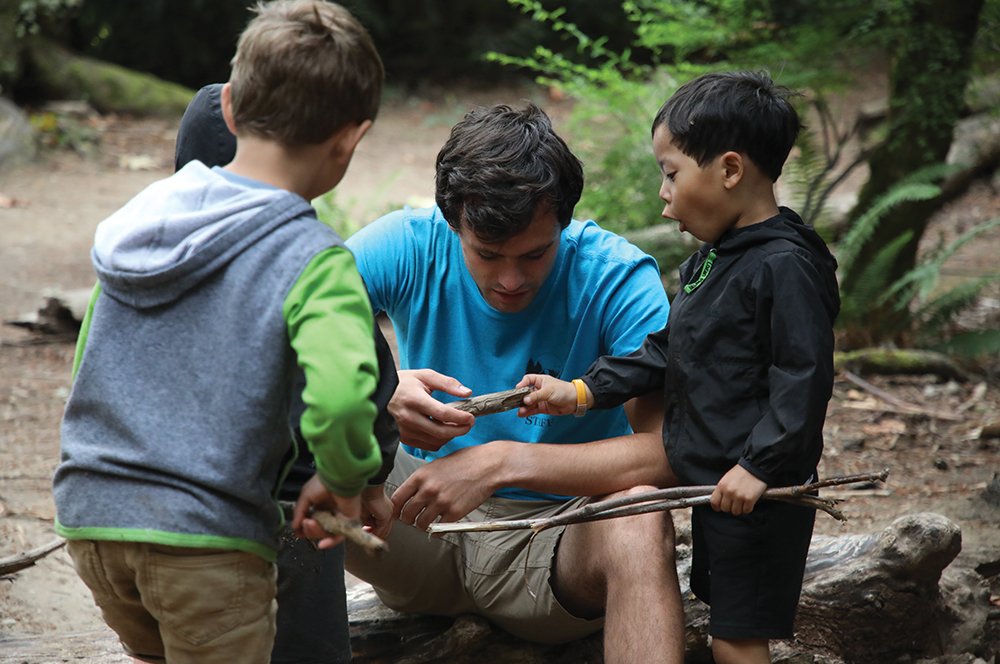
Coyote Mentoring flips traditional education on its head by drawing learning out of children rather than forcing it into them. This philosophy requires instructors to maintain a watchful eye, constantly scanning the group for moments when a specific discovery captures a camper’s attention. These fleeting instances create ideal, organic learning opportunities. A trained Coyote Mentor notices what is sparking a child’s natural curiosity and uses that specific point of interest as a catalyst to engage campers in active, self-driven learning. Through this subtle process, mentors create a space where knowledge is seamlessly passed on, often without the campers even realizing that an educational lesson is taking place.
Teetering On The Edge
Enlisting the art of questioning is another primary method Coyote Mentors use to stir up organic wonder. Instead of simply delivering facts—such as casually announcing that a feather found on the forest floor belongs to a Barred Owl—a Coyote Mentor responds with a cascade of targeted questions. They might ask the children what colors they notice in the plumage, what size bird they think the feather belonged to, how long it appears to have rested on the ground, or how it might have fallen from the canopy. Mentors deliberately begin with basic questions that campers likely already know how to answer, then progressively build toward more challenging levels of inquiry until the children reach what instructors call an "edge."
An awareness of a child’s individual edge is an essential component of the Coyote Mentoring model. When a camper reaches the edge of their engagement, they might temporarily appear distracted, hesitant, or stuck. Mentors pay exceptionally close attention to the group dynamic, skillfully guiding a member up to their personal edge while remaining acutely aware of when to pause, take a break, or move on to a different activity. They also continuously seek out prime opportunities for re-engagement.
To achieve this, mentors evaluate a multitude of factors, including the time of day, communication styles, distinct learning styles, and individual personality traits. Rather than forcing a rigid, one-size-fits-all teaching style onto every participant, a Coyote Mentor constantly adapts, catering directly to a camper’s preferred way of processing information based on continuous, careful observation.
Planting Seeds Engages An Audience
To maintain this fluid, responsive environment, instructors at the Wilderness Awareness School avoid strict, minute-by-minute agendas. While they may outline activities for the early part of the day, the schedule is purposefully left flexible, allowing the remainder of the itinerary to be determined by the natural flow, energy, and interests of the students.
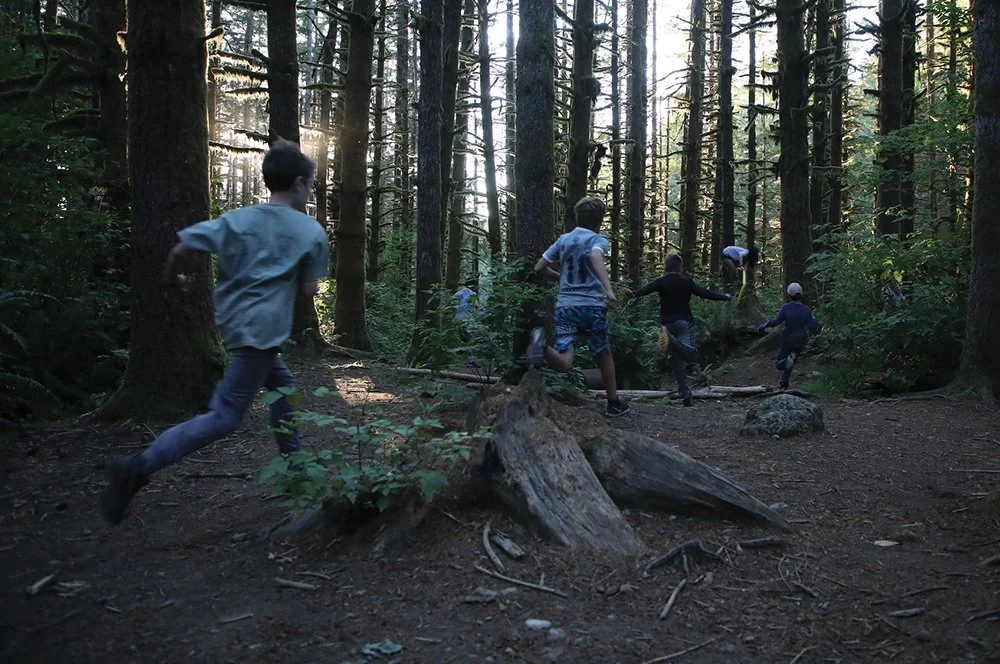
Typically, Coyote Mentors kick off each morning with an energetic game designed to break the ice, foster camaraderie, and help children burn off excess energy. During these activities, instructors subtly "plant seeds." For instance, a game might involve one camper playing an eagle chasing several designated sparrows, or children darting around an imaginary mud pit. The mentors closely monitor the group’s collective stamina, watching for the exact moment when a few campers begin to tire of the game, intervening just before the entire group loses interest. Capitalizing on this natural dip in energy, the mentors gather the children for a storytelling break.
Storytelling serves as yet another powerful vehicle for planting educational seeds. Compelling stories provide a relatable, engaging framework to draw out excitement and curiosity. A mentor might tell a narrative about a young girl who develops a special relationship with spiders, learning the art of web-weaving simply by observing the eight-legged creatures in her garden. Suitably inspired, the group of campers will often set off on a trek through the surrounding woods specifically to search for spiders, eager to witness firsthand how the creatures construct their webs.
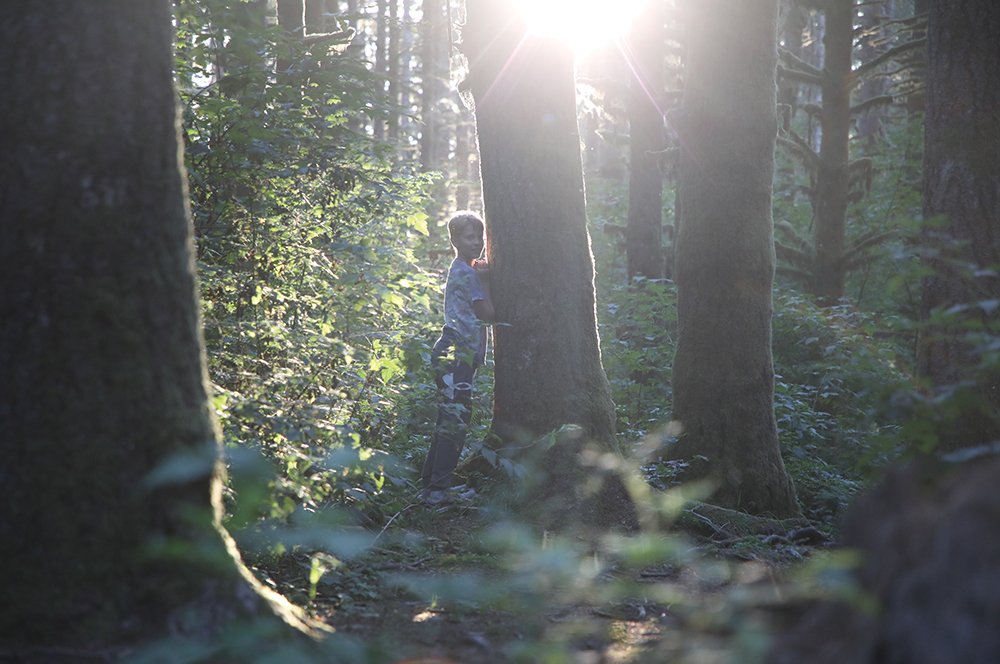
As they adventure through the landscape, campers step directly into their own awareness of the natural world, retaining the autonomy to decide which components of the ecosystem capture their imagination. The Coyote Mentor observes quietly, choosing either to ask relevant questions in the moment or to weave these specific curiosities back into the formal curriculum later in the day.
Later, mentors can recall the seeds planted earlier in the morning by directly referencing the day’s opening activities. Children who participated in the morning game involving an imaginary mud pit, for example, are often delighted when an afternoon adventure leads them to an actual, physical mud pit. Here, they have the freedom to reenact the morning’s game or simply dive in and get their hands dirty, transforming a standard day of summer camp into an unfolding, memorable narrative of their own.
Opportunities To Explore
By mastering the tools of questioning, storytelling, flow learning, and keen observation, mentors at the Wilderness Awareness School help young people forge lasting relationships with the natural world and with one another. By fostering these deep connections over the course of decades, the institution has consistently watched its students grow into resilient, compassionate, self-aware, and resourceful individuals.
While the Wilderness Awareness School might outwardly resemble a traditional nature camp—providing a space for children to breathe fresh air and make new friends during the summer months—the underlying experience is carefully curated by educators who understand the psychology of youth engagement. They provide children with the physical and mental space to explore, orchestrate intentional opportunities for discovery, and gently push them toward their personal learning edges. Ultimately, when a camper returns home at the end of the day, leaves their digital tablet on the coffee table, and spontaneously asks the family to go for a hike, the quiet work of the coyote mentor is complete.