Beyond Survival: Finding the Intersection of Hard Skills and Intuition at the Wild Women’s Weekend
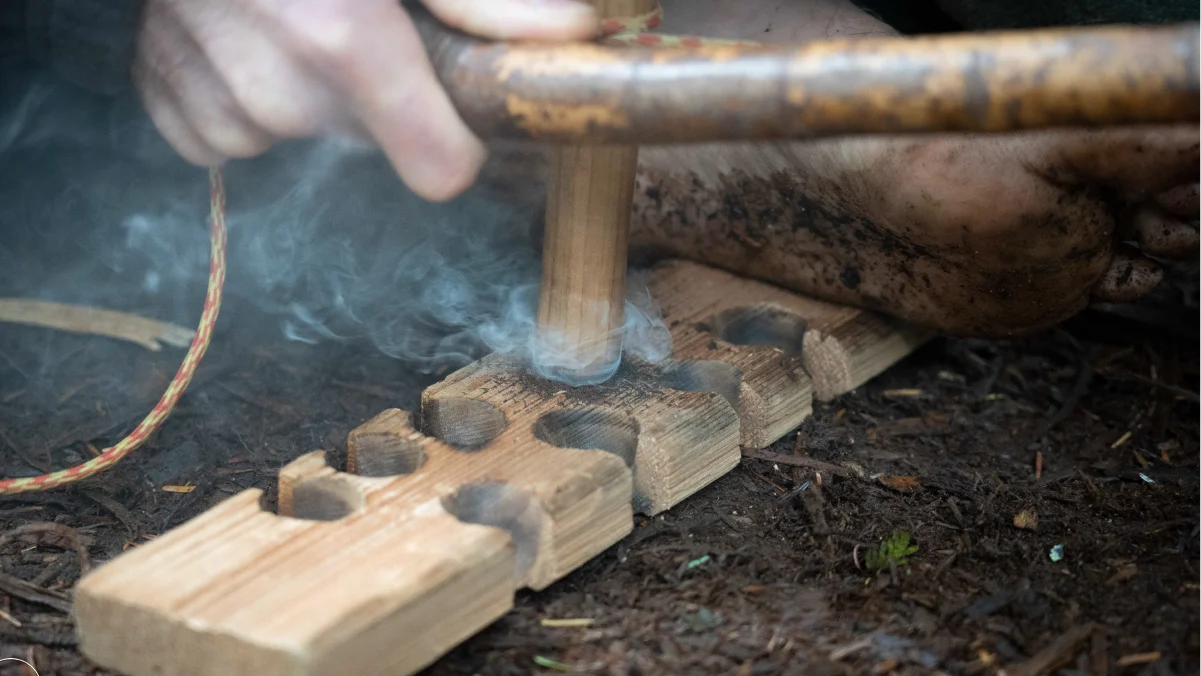
Before a single word of introduction was spoken at the Wilderness Awareness School’s Wild Women’s Weekend last October, the event’s host handed off a hypothetical torch to Marina Rivera, who stepped forward to ignite the ceremonial fire that would officially open the gathering.
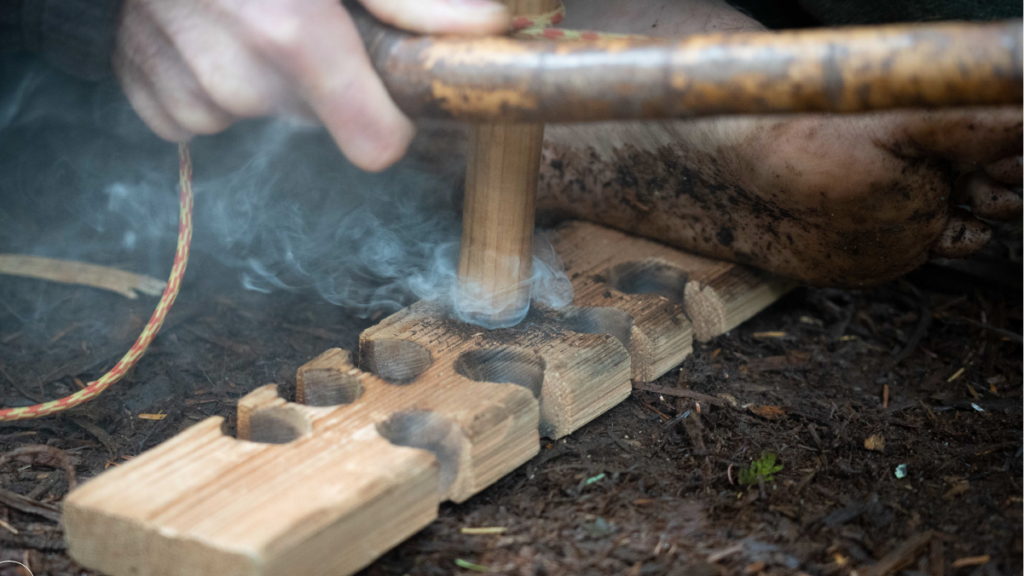
Moving in slow, deliberate, dancer-like steps, Marina approached a piece of wood held steady by her bare foot. She paused to take several large, steady breaths, closing her eyes to center herself. When she opened them, the process began. Using one hand, she held a wooden spindle, pressing its tip into a board on the ground. With her other hand, she grasped a handmade bow, sawing it smoothly back and forth. The motion caused rapid friction between the rotating spindle and the hearth board below.
Every few moments, she paused to take intentional breaths. Within a short time, thin wisps of smoke began to rise from the dark friction point, signaling the birth of a glowing coal. Carefully lifting the coal, she nestled it inside a soft tuft of shredded cedar tree bark. Kneeling close, Marina blew gentle, measured breaths into the bark until soft flames licked upward. She then transferred the nascent fire to a intricately carved feather stick—a piece of wood featuring thin, curled shavings coalescing at its tip—before finally moving the flame to a small pile of tinder waiting in the central fire pit.
And just like that, there was fire. It burned brightly for only a brief moment before Marina extinguished it, as a seasonal burn ban was firmly in place.
Throughout the entire ceremony, attendees found themselves utterly transfixed. Aside from the sound of Marina’s controlled breathing and the eventual crackle of the wood, the surrounding forest was quiet. Roughly 50 participants watched with rapt attention. While many of the onlookers, including author and researcher Elizabeth Doerr, were initially unfamiliar with the technical names of the tools being used, it was immediately clear that the demonstration transcended basic survival mechanics. It felt, undeniably, somewhat spiritual.
Even acknowledging that spiritual element can feel slightly uncomfortable, particularly for those navigating a modern, back-to-the-land journey. Yet, watching Marina conjure fire from raw elements while seemingly tuning out the gaze of over a hundred watching eyes sparked a deeper realization. Crafting fire was not merely a mechanical, hard skill; it was anchored in something softer, something rooted deeply in intuition and emotional presence.
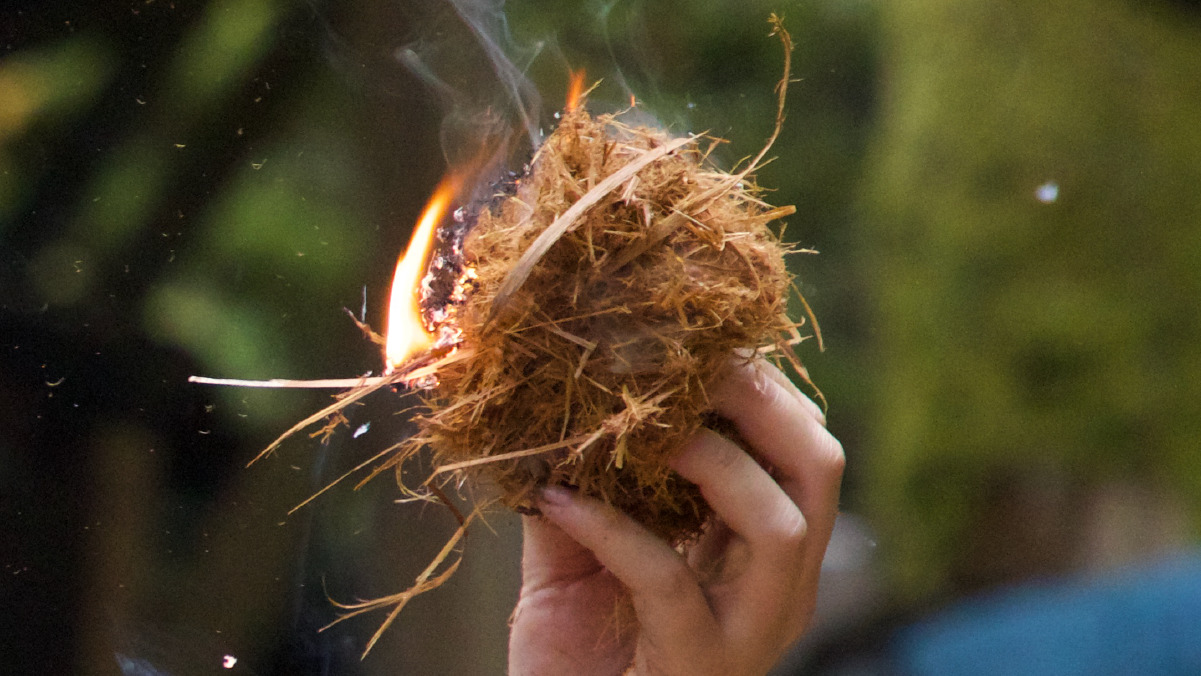
That observation was reinforced later when participants broke into smaller workshop groups. Marina led the fire-making session, introducing the group to the essential tools of primitive friction firecraft: the bow drill, cedar bark, feather sticks, and kindling. Excitement rippled through the group at the prospect of finally learning how to harness fire from the raw materials scattered across the surrounding landscape.
Then came a perspective-shifting piece of advice from the instructor. Marina explained that while carrying modern fire-starting tools—what she lightheartedly referred to as nature’s blowtorch—can be useful, relying on them entirely is often a direct compensation for a lack of genuine understanding of one’s natural environment. As a person truly gets to know the land, those artificial crutches become unnecessary, though learning that level of deep ecological literacy takes far longer than a brief afternoon workshop.
For participants balancing busy modern lives, becoming a master of the local ecology overnight was unrealistic, but the underlying philosophy proved magnetic.
Following a thorough briefing on safety rules—essential when handling sharp knives and hatchets—Marina demonstrated the foundational steps of the craft. She walked the group through wood-chopping, fuel gathering, feather stick production, and fire lighting using a ferrocerium rod and knife. Watching her work highlighted the immense amount of preparation required long before a single spark is ever struck. Furthermore, Marina deliberately used the phrase "getting fire" rather than "making fire."
When asked about the distinction, she explained that drawing fire requires technical proficiency combined with emotional attunement. In her view, fire is fundamentally ingrained in human biology and history, serving not only as a physical center for community but as a reflection of human identity itself.
The concept of "getting fire" implies that fire already exists within the materials and the environment; the human role is simply to become open and receptive to it. Watching Marina’s graceful opening ceremony under the pressure of a large, expectant audience demonstrated just how vital that mind-body attunement truly is.
This linguistic and philosophical shift illuminated a broader truth about the journey of wilderness skill acquisition. The division between "hard skills"—quantifiable, objective abilities built through repetitive practice—and "soft skills"—subjective, qualitative traits like critical thinking, patience, and active listening—is not as rigid as it often seems. Instead, they exist along a continuous spectrum.
While building a primitive fire demands concrete knowledge, such as gathering the correct volume and species of bark, mastering the precise angle of a ferro rod, or sizing kindling correctly, technical perfection guarantees nothing. Even with flawless execution, fire is never a mechanical certainty. Bringing a spark to life requires presence, patience, and intuition.
By the end of the workshop, participants put these lessons into practice. Many successfully chopped wood, crafted functional if imperfect feather sticks, scraped cedar bark for tinder, and coaxed sparks from ferro rods into tiny embers that blossomed into flames. However, when participants faced a timed challenge to produce a fire using only a single match within five minutes, the psychological pressure shifted the dynamic entirely.
For some, the sudden rush of adrenaline and frustration made the task elusive. Heart rates climbed, and doubts surfaced about whether they possessed the inherent capability to succeed. Yet, those moments of struggle reinforced a core teaching from the instructor: if the fire refuses to come, forcing the issue is counterproductive, and a change in approach is required. Marina had noted earlier that it is far better to remain calm and without fire than to panic and force an unsafe outcome. The objective is to invite the fire in rather than battle the materials into submission. Without the right mental space, technical preparation alone falls short.
This realization underscored the holistic nature of the Wilderness Awareness School’s curriculum. The weekend balanced sessions focused on mindfulness and nature play with more technical workshops on fire and plant identification. Yet every component demanded an acute awareness of both the natural world and the self, anchoring them firmly in the realm of soft skills.
For individuals hesitant to embrace the hyper-masculine, rigidly technical focus often associated with traditional prepper communities, this approach offers an alternative framework. It views skill-building not as a frantic race toward absolute mastery, but as an ongoing refinement of human intuition in harmony with the environment—proving that the soft skills of awareness and presence may ultimately be the most vital tools of all.
