Beyond Enrichment: Comprehensive Research Reaffirms the Central Role of the Arts in Modern Education
For over a century, educators, cognitive scientists, and researchers alike have recognized a fundamental truth about human development: the arts are far more than mere enrichment or optional extracurricular activities; they are essential to the very fabric of learning. From music and drama to drawing, painting, and storytelling, artistic expression has consistently been shown to strengthen academic achievement, foster creative problem-solving, enhance long-term memory, and build crucial social-emotional skills. While many modern school districts continue to debate whether the arts should be treated as essential curriculum or expendable perks during budget crunches, a robust and growing body of empirical research demonstrates that artistic integration is central to overall student growth, wellbeing, and long-term success.
Education as an Art
The foundational idea that teaching itself is an art form has deep roots in pedagogical history. Effective educators are not simply passive conveyors of standardized information; they function as creative guides who awaken natural curiosity, invite deep exploration, and help students perceive the world from fresh perspectives. Lessons infused with rhythm, imagination, and narrative allow children to connect abstract knowledge with tangible human experience.
A major randomized trial conducted in Texas, entitled Investigating Causal Effects of Arts Education Experiences, provided compelling experimental evidence from the Houston Arts Access Initiative. The study revealed that elementary and middle school students in schools with significantly enhanced arts programming not only performed measurably better in standardized writing assessments, but they also displayed fewer disciplinary infractions and demonstrated notably higher levels of empathy toward their peers. When teaching is approached as an intentional art form, the scope of learning extends far beyond traditional academic metrics into the vital realms of personal character, community cohesion, and shared humanity.
Academic Achievement and the Arts
For decades, arts-rich learning environments have been strongly correlated with higher overall academic performance across diverse student demographics. The landmark federal report Arts and Achievement in At-Risk Youth revealed that students who maintain deep and sustained involvement in the arts consistently earn better grades, graduate from high school at higher rates, and exhibit a much stronger propensity to aspire to higher education.
More recently, publications from the National Endowment for the Arts (NEA), including Snapshots of Arts Education in Childhood and Adolescence, have reaffirmed these findings, documenting consistent, measurable gains in reading comprehension, mathematical reasoning, and language development when regular arts participation is integrated into the daily curriculum.
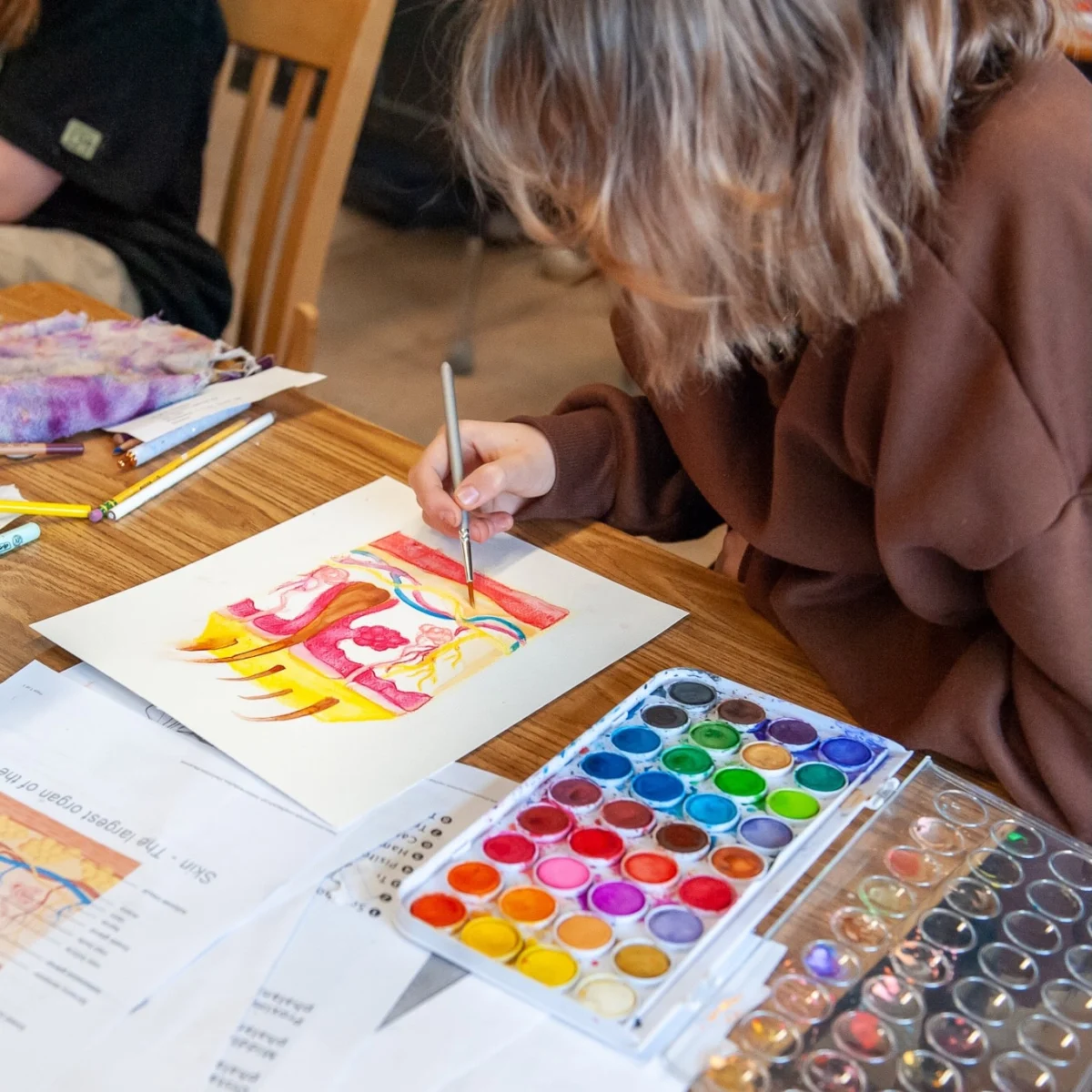
Specific cognitive studies further illuminate why this connection exists. In a prominent 2019 study led by researcher Mariale Hardiman and her colleagues, entitled The Effects of Arts-Integrated Instruction on Memory for Science Content, investigators discovered that students who learned core science concepts through arts-based methods retained and transferred knowledge significantly more effectively than control groups taught through traditional instructional approaches. This research underscores a methodology that many innovative classrooms already practice: complex abstraction becomes far more accessible when introduced through hands-on artistic exploration. Whether students are drawing geometric forms before tackling complex geometry formulas or illustrating the phases of a scientific experiment as a core component of the learning process, the arts provide a cognitive bridge to understanding.
Creativity and Critical Thinking
In today’s rapidly evolving global landscape, creativity is no longer viewed as a luxury or a specialized talent; it is an absolute necessity for economic and social navigation. A comprehensive report from the Organisation for Economic Co-operation and Development (OECD), titled Art for Art’s Sake?, highlights the profound ways in which arts education actively fosters flexible, innovative thinking patterns.
Extensive studies consistently confirm that students who routinely engage in rigorous artistic activities develop significantly stronger divergent thinking skills. These cognitive capacities enable young learners to generate original ideas, synthesize disparate concepts, and adapt fluidly to novel, unexpected situations. Whether they are composing original music, performing in theatrical drama, or painting a landscape, the arts cultivate persistence, originality, and multifaceted problem-solving capacities that seamlessly translate across all academic and professional disciplines.
Memory, Engagement, and Multisensory Learning
The mechanisms behind artistic practice also shed light on how human memory and student engagement operate. The research spearheaded by Hardiman and her team demonstrates that arts-integrated instruction leads to deeper long-term recall of academic content because the arts inherently activate multiple sensory pathways simultaneously—engaging visual, auditory, and kinesthetic processing systems.
By anchoring abstract knowledge in embodied, physical experience, learning becomes durable. Reciting poetry with rhythmic movement, singing a mathematical concept, or physically illustrating historical events embeds information into the human brain far more powerfully than rote memorization and passive listening ever could. This multisensory approach honors the natural ways children process the world around them.
Social-Emotional Growth
Beyond the boundaries of traditional academic subjects, the profound benefits of arts education extend deeply into the social-emotional domain. The Houston-based study by researchers David Kisida and Brian Bowen noted marked increases in compassion, tolerance, and civic engagement among students who experienced heightened exposure to the arts.
Similarly, the NEA report Arts in Early Childhood: Social and Emotional Benefits of Arts Participation documented that collaborative storytelling, group music-making, and theatrical drama actively build cooperation, interpersonal empathy, and psychological resilience in young learners. Working together toward a shared creative goal—such as producing a school play, harmonizing in a choir, or executing a collaborative mural project—demands active listening, patience, compromise, and shared responsibility. These experiences forge essential life skills that prepare students for the collaborative demands of the modern workforce and community life.
Equity and Access
Despite overwhelming empirical evidence supporting their value, arts and music programs are historically among the first areas targeted for budget cuts when school districts face financial tightening. Yet, extensive research demonstrates that robust arts engagement can serve as a powerful socioeconomic equalizer.
Data compiled by the NEA indicates that low-income students who maintain deep involvement in the arts routinely outperform their socioeconomically disadvantaged peers academically, demonstrate higher rates of college attendance, and show greater levels of active participation in civic life. The Kennedy Center’s national Turnaround Arts initiative has confirmed comparable outcomes on a broader scale, recording consistent improvements in daily attendance, student behavior, and overall school climate in historically underfunded schools that chose to embrace comprehensive arts integration.
A Universal Call
The gathered evidence from educational researchers, neuroscientists, and cultural institutions remains unequivocal: the arts are not peripheral luxuries, but core pillars of a complete education. They elevate academic performance, spark genuine creativity, deepen long-term memory retention, and nurture vital human empathy. Schools that fully and intentionally integrate the arts—whether through music, visual art, physical movement, drama, or narrative storytelling—embody what decades of educational research affirm as best practice for human learning.
For more than a century, educational traditions such as those found in Waldorf schools have provided a tangible example of what this complete integration looks like in everyday practice, weaving the arts into every academic subject as a matter of foundational principle. Within this framework, the arts are recognized not as optional add-ons, but as the essential medium through which all academic subjects are brought vividly to life.
