Beyond Survival: Redefining Primitive Fire-Making at the Wilderness Awareness School’s Wild Women’s Weekend
Last October, beneath the crisp autumn air of the Pacific Northwest, fifty women gathered at the Wilderness Awareness School’s annual Wild Women’s Weekend for a journey into traditional wilderness skills. Before formal introductions could even begin, the weekend’s host passed a symbolic torch to Marina Rivera, who was chosen to ignite the ceremonial fire that would officially open the gathering.
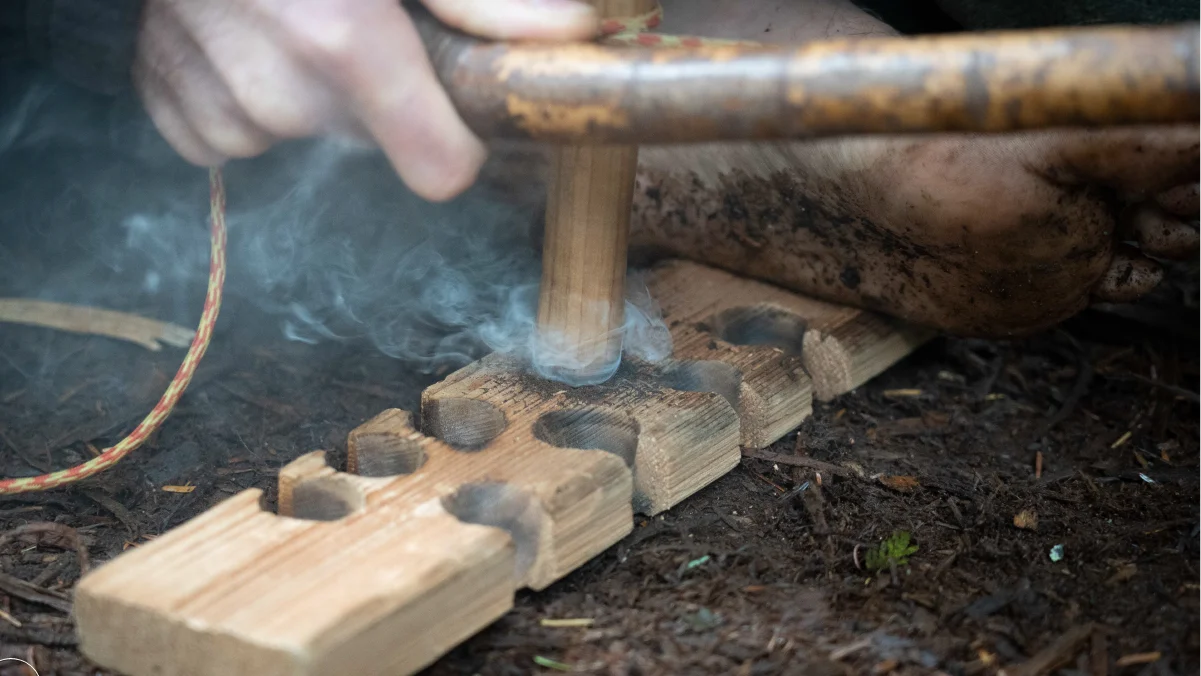
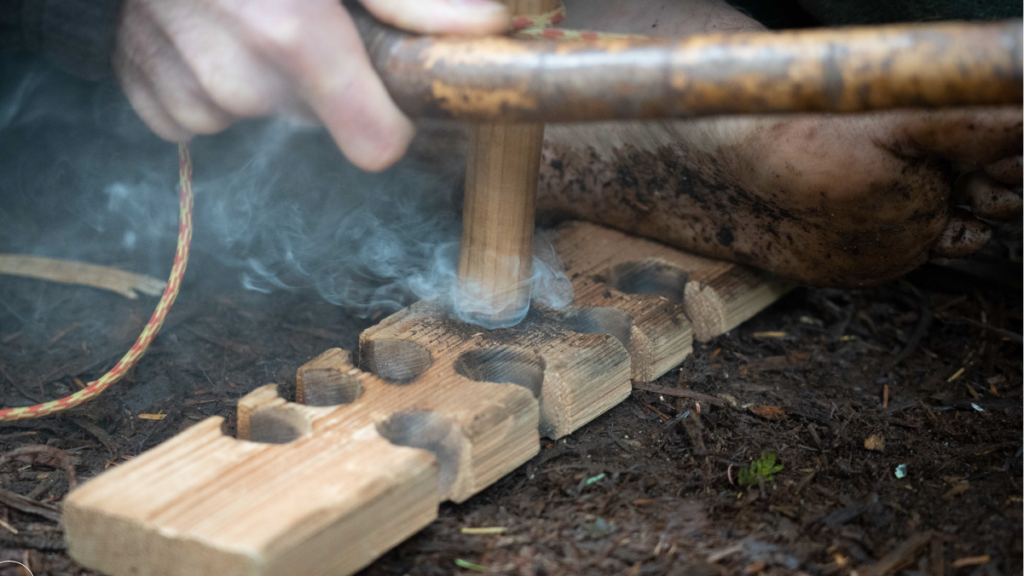
Without a word, Marina stepped forward in slow, deliberate, dancer-like movements toward a piece of seasoned wood held securely beneath one bare foot. Taking several deep, steady breaths, she closed her eyes to center herself. When she opened them, the work began. With one hand, she pressed a wooden spindle firmly into a small depression on the board resting on the ground. Holding a handmade bow, she began to saw rhythmically, pulling the cord back and forth to spin the spindle at high speed. The resulting friction generated a fine, dark powder and mounting heat between the spindle and the lower board.
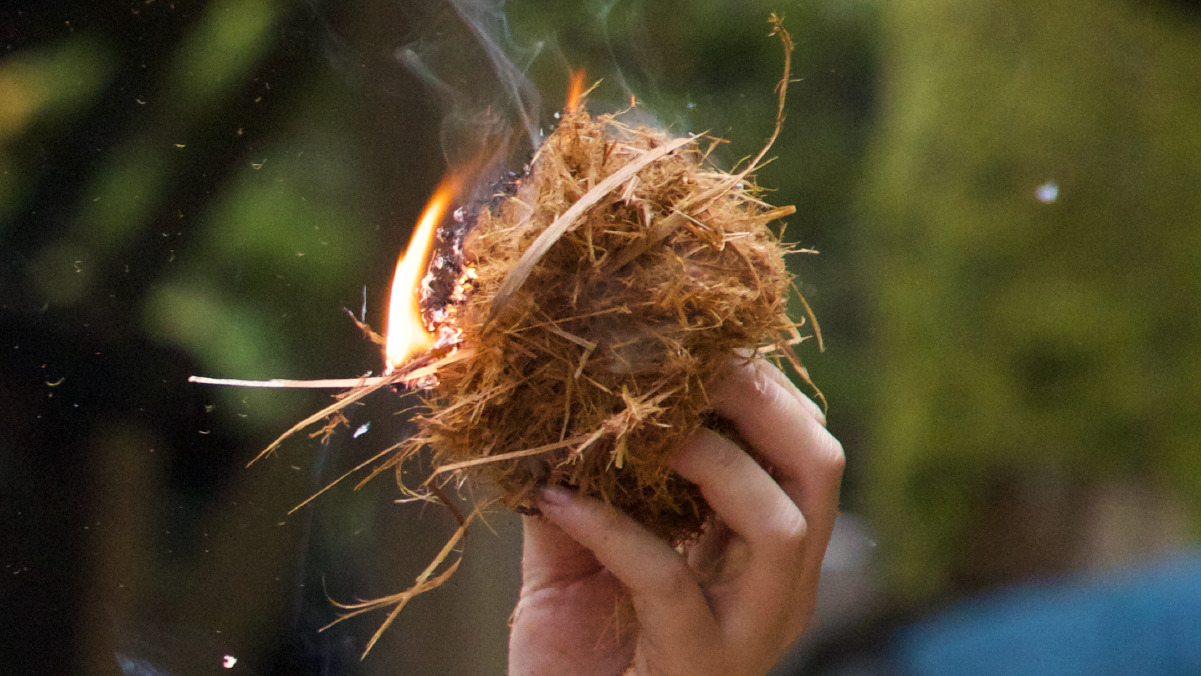
Every few moments, Marina paused to take a measured, intentional breath. Before long, thin wisps of grey smoke began to rise from the drilled hole, signaling the birth of a tiny, glowing coal. Moving with practiced care, she lifted the delicate spark and placed it inside a soft, prepared tuft of fibrous cedar tree bark. Kneeling close to the earth, she blew gentle, rhythmic breaths into the bark until a vibrant flame flickered to life. She transferred the nascent fire to a carved feather stick—a piece of wood trimmed with delicate, curling ribbons that caught the flame instantly—before finally moving it to the central fire pit.
For a brief, powerful moment, the fire burned brightly in the clearing. Yet, due to a seasonal burn ban currently in effect, Marina inevitably had to extinguish the very flame she had just worked so carefully to bring into existence.
Throughout the ceremony, the gathered attendees watched in
absolute, rapt silence, save for the sound of Marina’s steady breathing and the faint crackle of the wood. For many observers, including myself, the demonstration transcended the mechanics of primitive survival. Though the tools—the spindle, the bow, the cedar bark—were unfamiliar, the underlying act felt distinctly, unmistakably spiritual.
Acknowledge that feeling of spiritual resonance can sometimes invite hesitation, particularly for anyone navigating a back-to-the-land journey or modern self-reliance movement. Yet watching Marina draw fire from seemingly nothing, maintaining absolute focus while more than a hundred eyes remained fixed on her, revealed something vital. Fire-making was far more than a purely mechanical, hard-earned survival skill; it was deeply rooted in intuition, presence, and an intimate awareness of the natural world.
That realization was reinforced later that morning when participants broke into smaller groups for hands-on workshops. Marina led the session on primitive friction fire-making, introducing the participants to the fundamental equipment: the bow drill, cedar bark, feather sticks, and fine kindling. The prospect of finally learning how to generate fire using only the materials scattered across the surrounding forest floor filled the participants with a renewed sense of anticipation.
Then, Marina offered an insight that fundamentally reframed the entire concept of wilderness survival.
"I can carry all the tools to make a fire: nature’s blowtorch," Marina explained to the group. "While those are great, they’re a direct compensation for our lack of knowledge about our environment."
The statement struck a chord. Recollections of past camping trips surfaced—memories of struggling with a Ferro rod and stubborn kindling, ultimately resorting to a disposable lighter out of sheer frustration and the pressing need to feed hungry children. The realization that traditional survival gear often serves merely as a crutch for unfamiliarity with the landscape was both humbling and motivating.
"As I get to know the land, I don’t need to carry those things," Marina continued, before adding with a smile, "But that’s not what this class is about."
True to her word, mastering the intricate ecology of a forest in a brief two-hour workshop was impossible. Yet the participants were entirely hooked, ready to embark on that long-term journey of learning.
Following a thorough review of safety protocols required when handling sharp blades and tools, Marina demonstrated the exhaustive groundwork necessary before a single spark is struck. The curriculum covered wood-chopping, fuel gathering, crafting feather sticks, and utilizing a knife and Ferro rod. Watching the demonstration underscored a fundamental truth: an immense amount of preparation occurs long before anyone attempts to create a flame. Furthermore, Marina consistently used the phrase "getting fire" rather than "making fire."
When asked about the distinction, Marina paused to reflect before offering her perspective.
"[Getting fire] requires skill, but also emotional attunement," she explained. "I think that as human beings, fire is ingrained in our bodies. Not just a center for community, but who we are. I see metaphors for fire everywhere."
The terminology implied that fire already exists within the environment, waiting to be unlocked rather than forced into existence. Remembering Marina’s graceful, composed opening dance at the center of the circle, it became clear that the pressure of the moment required total attunement between task, mind, and body.
This insight illuminated the broader spectrum connecting hard and soft skills. In the context of wilderness preparedness, hard skills represent quantifiable, objective abilities cultivated through time and repetition, such as gathering the correct volume of bark, striking a Ferro rod at the precise angle, or processing kindling to exact specifications. Soft skills, by contrast, encompass qualitative, subjective attributes like critical thinking, active listening, patience, and intuition. Even when every technical parameter is met precisely, a fire is never guaranteed. Securing fire ultimately demands presence and emotional composure.
By the conclusion of the workshop, every participant successfully secured fire. Working through the process involved chopping wood, fashioning functional if imperfect feather sticks, scraping the interior of a cedar plank to gather soft fibers, and generating a spark with a Ferro rod that caught a small piece of dehydrated denim charcoal. Breathing gently into the cedar tuft coaxed the spark into a flame, which was then transferred to the feather stick and laid in the pit.
However, the subsequent challenge—attempting to generate a fire using only a single match within a strict five-minute window—revealed the disruptive power of pressure and anxiety. Struggling against the clock, heart pounding with self-doubt, several participants fell short of the goal, questioning their capability.
Reflecting on the struggle brought back another piece of Marina’s earlier guidance: "If the fire doesn’t come, you need to do something different."
The variable that had changed under the pressure of the timed test was mental state, not technical competence. Though many attendees succeeded in the single-match challenge, the moments of frustration provided an invaluable lesson. Reviewing notes and recalling Marina’s advice offered clarity.
"I personally believe it’s better to be calm and not have fire than panicking and having a fire," Marina had noted during the session. "Try to invite the fire on versus trying to make the fire."
Without the proper mental space to receive the fire, technical execution alone proved insufficient. The experience underscored the profound spiritual and psychological dimensions woven into traditional skill-building. The curriculum at the Wilderness Awareness School intentionally balanced activities, dividing time evenly between mindfulness exercises, nature play, and technical disciplines like fire crafting and plant identification. Every session demanded a foundational awareness of both the natural environment and one’s internal state.
For many women drawn to the weekend, this holistic philosophy offered a welcome alternative to the hyper-masculine, rigidly technical focus often dominating traditional prepper communities. The school’s approach provides a sense of grace, acknowledging that skill development exists on a broad spectrum rather than a linear race toward mastery. By prioritizing intuition alongside technical competence, programs like the Wild Women’s Weekend redefine what it truly means to be prepared, proving that resilience in an uncertain world relies just as much on inner awareness as it does on gear.
Elizabeth Doerr is a published author and writer for her blog and future book, Cramming for the Apocalypse. She attended the fall session of Wild Women’s Weekend as part of her ongoing research and personal journey.
