Beyond Survival: Redefining Primitive Skills at the Wilderness Awareness School’s Wild Women’s Weekend
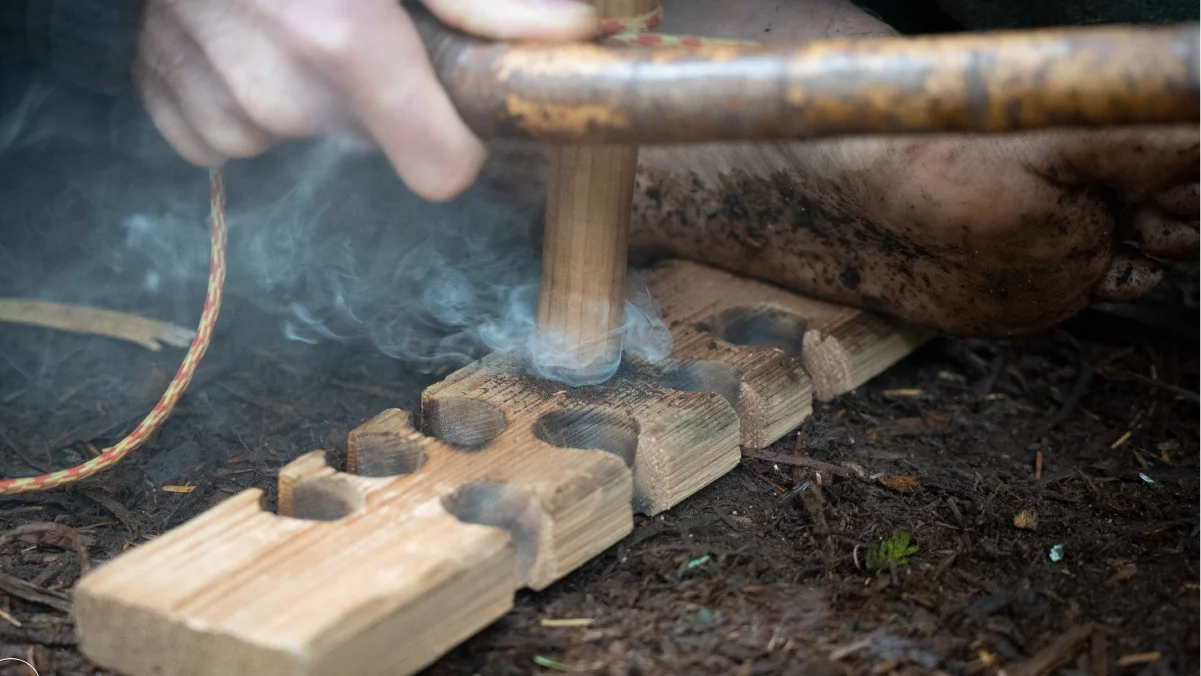
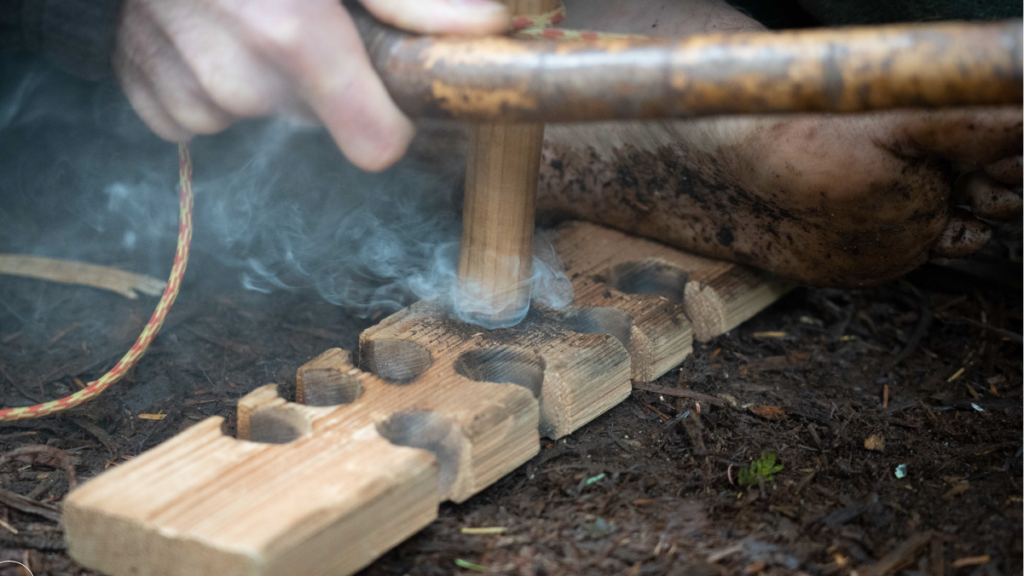
Before a single introduction was made at the Wilderness Awareness School’s Wild Women’s Weekend last October, the event’s host handed off a hypothetical torch to Marina Rivera, who was tasked with lighting the first ceremonial fire to inaugurate the gathering. Moving with deliberate, unhurried grace, Rivera stepped toward a piece of wood held in place by one bare foot. She took several slow, deep breaths, closed her eyes for a moment, and began.
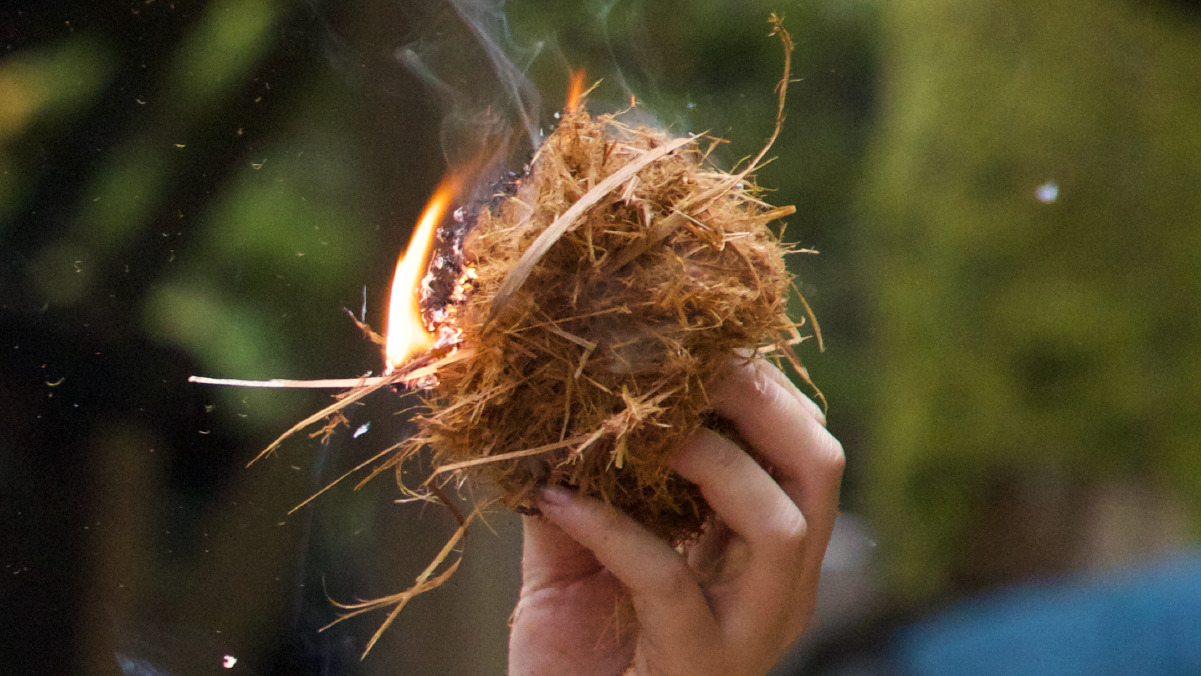
Using one hand, she held a wooden spindle upright, driving it into a hearth board on the ground. With the other hand, she worked a handmade bow back and forth, causing the spindle to spin rapidly and generate friction against the wood below. Periodically, she paused to take intentional breaths. Within moments, thin wisps of smoke began to curl upward from the friction point, revealing a glowing ember. Rivera carefully lifted the hot coal and transferred it into a soft tuft of shredded cedar tree bark.
Kneeling close to the ground, she blew gentle, measured breaths into the bark. As soft flames erupted from the fibers, she transferred the fire to a "feather stick"—a carved piece of wood featuring delicate, curled shavings that gathered at the tip. From there, the flame was quickly moved to a small pile of tinder nestled in the center of the stone fire pit. And just like that, fire was born—though it was extinguished moments later to comply with an active local fire ban.
Throughout the silent, focused ceremony, the gathered crowd of roughly 50 attendees watched in absolute silence, captivated by the process. Aside from the steady sound of Rivera’s breathing and the eventual crackle of the wood, the clearing was entirely still. For many observers, including first-time participants unfamiliar with primitive survival gear, it was immediately clear that something far deeper than mere utility was taking place. The demonstration carried an undeniable, almost spiritual resonance.
For those engaging in a modern back-to-the-land lifestyle or exploring emergency preparedness, acknowledging a spiritual element can sometimes feel overly sentimental or on-the-nose. Yet, watching Rivera build a fire seemingly out of thin air while maintaining absolute composure amidst a hundred attentive eyes highlighted a profound truth: mastering a traditional skill like fire-making requires far more than mechanical execution. Beneath the technical mechanics lies a softer foundation rooted heavily in intuition and emotional presence.
This realization was reinforced later during breakout workshops. Rivera led the fire-making session, introducing participants to the fundamental tools of primitive friction fire: a bow drill, fibrous cedar bark, handcrafted feather sticks, and fine kindling. The prospect of successfully generating fire using only natural materials gathered directly from the surrounding landscape generated considerable excitement among the participants.
However, the introductory lecture shifted perspectives immediately when Rivera offered a piece of foundational philosophy. She explained that while carrying modern survival gear or specialized tools can be effective, relying entirely on them acts as a direct compensation for a lack of genuine understanding of one’s surrounding ecosystem. True resilience comes from knowing the land, though acquiring that depth of knowledge takes time far beyond a single weekend workshop.
As the session progressed into practical applications, Rivera demonstrated the essential labor required long before a spark is ever struck. Participants learned the mechanics of wood-chopping, fuel gathering, feather-stick manufacturing, and fire-lighting using a ferrocerium rod and a knife. A significant takeaway from the instruction was the deliberate terminology Rivera used: she consistently spoke of "getting fire" rather than "making fire."
When asked about the distinction, Rivera explained that securing fire demands both technical capability and emotional attunement. In her view, human connection to fire is deeply ingrained in our biology, serving not only as a historical center for community and warmth, but as an essential reflection of human identity itself.
The concept of "getting fire" implies that the flame is already present in the environment, waiting to be unlocked by someone open and receptive to it. This reframing shed new light on the graceful, pressure-filled opening ceremony where Rivera had successfully ignited the first spark of the weekend in front of an eager audience.
This insight bridged the gap between hard and soft skills on the preparedness journey. Hard skills represent quantifiable, objective abilities refined through repetition and mechanical practice, such as gathering the correct volume of bark, mastering the angle of a bow drill, or sizing kindling correctly. Soft skills, by contrast, encompass subjective, qualitative capacities like critical thinking, patience, and active listening. Fire-getting perfectly unites the two domains; even when every technical variable is executed correctly in theory, absolute success is never guaranteed.
Ultimately, workshop participants experienced the satisfaction of securing fire independently. Working through the physical demands—chopping wood, scraping cedar bark to create fine tinder, and striking a ferro rod to catch a spark on dehydrated denim—led to the successful creation of small, sustainable flames.
Yet, when the exercise shifted to a higher-pressure challenge involving lighting a fire with a single match within a strict five-minute window, the psychological reality of survival mechanics became starkly apparent. The mounting pressure accelerated heart rates, triggered frustration, and tested self-confidence.
Reflecting on the challenge brought back a crucial piece of guidance from earlier in the day: if a fire refuses to ignite, the approach must change, and forcing the process never works. Rushing under duress or panicking yields poorer results than remaining calm. As Rivera noted, true preparedness means prioritizing emotional regulation over frantic action, inviting the fire to come rather than forcing it into existence.
The overarching philosophy of the Wilderness Awareness School event centered precisely on this spectrum between tangible wilderness techniques and internal awareness. While the weekend’s schedule balanced activities ranging from mindfulness and nature play to intensive plant and fire studies, every single session relied fundamentally on a deep, intuitive understanding of nature and the self.
For individuals exploring self-reliance outside of the hyper-masculine, rigidly technical prepper communities, this holistic approach offers a welcoming alternative. By framing skill-building as an ongoing refinement of personal intuition rather than a race toward absolute mastery, the curriculum emphasizes grace and adaptability. Ultimately, understanding the basics while cultivating a quiet, intuitive connection to the environment may prove to be the most vital asset of all.
