The Palette of Pluralism: How Interfaith Artists Are Using Creativity to Bridge Divides
In an era increasingly defined by polarization, cultural friction, and deep-seated ideological divides, communities around the world are continually searching for new avenues to foster mutual understanding. While traditional dialogue formats, academic panels, and policy debates remain vital pillars of civic engagement, a growing movement suggests that the answers to our most persistent societal fractures might not be found in words alone. Across the country, a diverse collective of creatives is looking toward a different kind of language: art.
What is the role of art in a pluralistic society? This fundamental question recently brought together members of the Emerging Leaders Network through Interfaith America, a prominent organization dedicated to building bridges across religious and philosophical differences. Connecting with three distinct artists, each of whom approaches interfaith cooperation through a unique artistic medium, the initiative explored a profound inquiry: How do faith traditions and deep engagement with unfamiliar traditions shape creative work? Furthermore, how can the arts actively foster curiosity, empathy, and unbreakable human connections across vast lines of difference?
The Artist’s Life
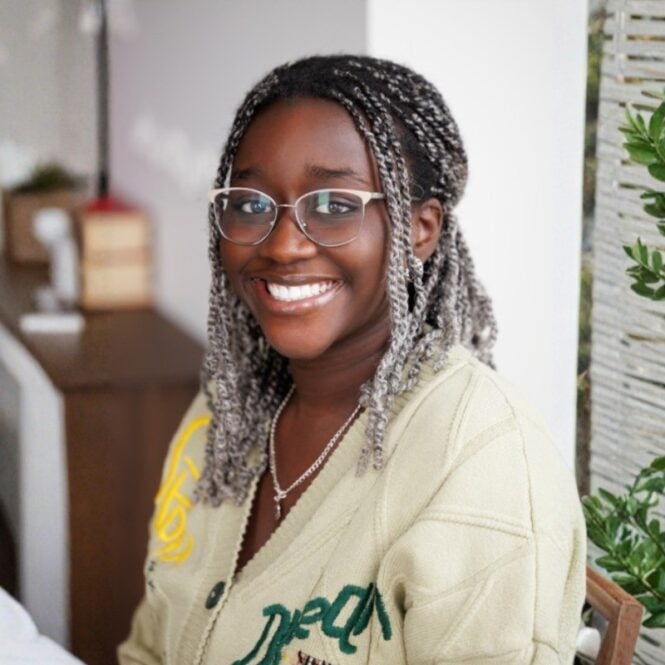
For Rose Sall, an Interfaith Innovation Fellow and the creative force behind the acclaimed storytelling project The Spirits in Me, art has been an inseparable companion to her interfaith journey since she was just eighteen years old. Sall’s work uniquely confronts historical religious conflicts through wordless comics, using visual narrative to explore complex themes where spirituality and identity intersect with generational trauma and history.
In Sall’s view, the canvas offers a unique space for reconciliation that traditional discourse sometimes struggles to reach.
“I’ve learned that relationship doesn’t require sameness,” Sall reflected, discussing her extensive interfaith experiences and how the distinct medium of illustration naturally allows for multiple, varied interpretations. “Art is the way I try to practice that. It gives people a form of their own to bring into the room.”
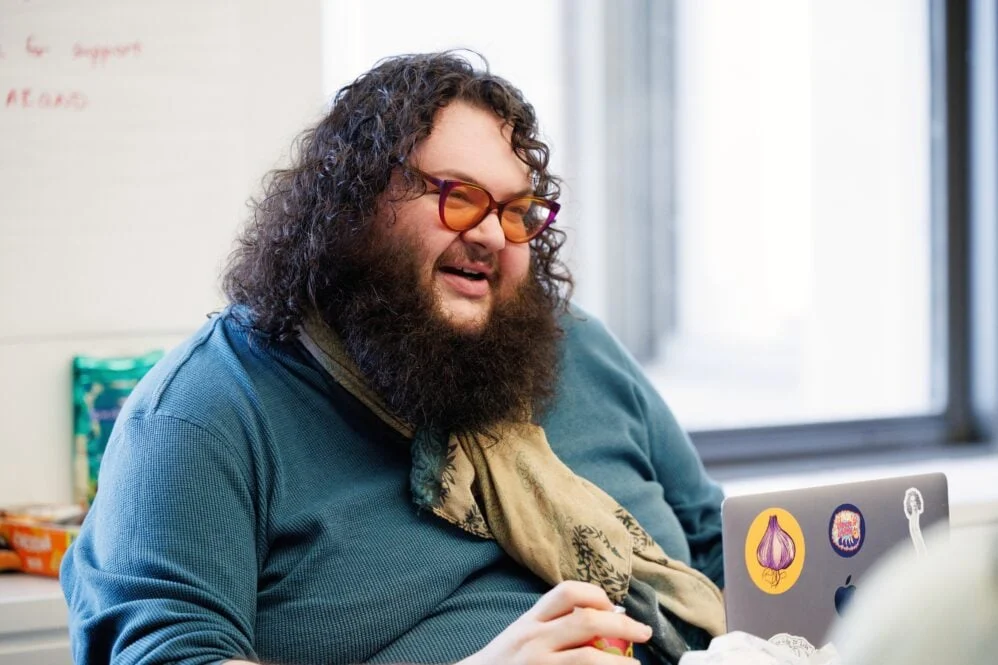
That sentiment is shared by Max Yeshaye Brumberg-Kraus, another Interfaith Innovation Fellow whose creative practice spans multiple disciplines. Describing their work as an interdisciplinary endeavor, Brumberg-Kraus operates as a writer, theo-poet, and facilitator of specialized gender and spirituality workshop series throughout the Twin Cities. For them, creation is not merely a hobby or a profession, but a vital, holistic necessity.

“Art is a full-bodied experience,” Brumberg-Kraus explained. “We all need ways to process the chaos around us into meaning, into form, into beauty and justice. It accounts for life’s goods and bads, knowns and unknowns. As far as I’m concerned, the point of art is to live into the fullness of life, while the point of life is to live artfully.”
Drawing from Religious Traditions
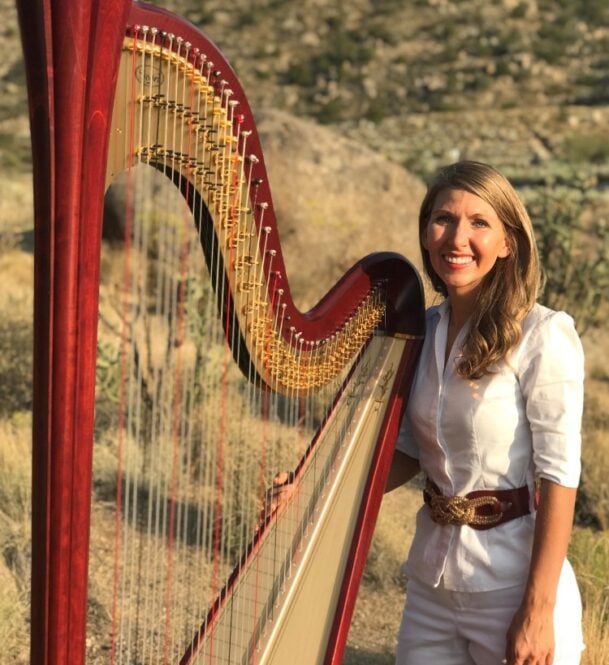
This deep integration of creativity and worldview is equally evident in the work of Keryn Wouden, a longtime participant in Interfaith America’s Emerging Leaders Network and co-lead of the Arts & Culture Interfaith at Work Cohort. A member of the Church of Jesus Christ of Latter-day Saints, Wouden expresses her spirituality and her commitment to bridgebuilding through music, primarily as a classical harpist.
For Wouden, the act of making music is both deeply personal and outwardly expansive. It serves as a spiritual conduit that links her internal devotion to the external realities of a diverse world.
“Music helps me connect both internally and externally to the world around me. I do feel it is a gift that I’ve been given and have felt throughout my life that my Heavenly Father would like for me to use that gift for the benefit of others,” Wouden shared.
Grounded in the foundational belief that humanity shares an innate creative spark, Wouden views her musical endeavors as a practical application of faith—a tangible method for improving the human condition. Driven by the philosophy that “we are all inherently creators,” she maintains a clear and intentional vision for her art.
“That is my hope. I want to use my music to make the world better and build connections,” she noted.
Brumberg-Kraus finds a similarly profound intersection between their artistic output and ancient sacred texts. As a graduate of the Theological Seminary of the Twin Cities rooted in Jewish tradition, Brumberg-Kraus reads foundational scriptures through an artistic lens.
“The Tanakh, the scriptures at the heart of my Jewish practice, reads as a long story about God’s artistic maturation across generations,” they observed.
This theological framing informs Brumberg-Kraus’s broader educational and community work. Guided by the core Jewish value of communal responsibility—paired with its artistic counterpart: a creative responsiveness to the world—they design workshops aimed at lowering emotional barriers. By centering embodied techniques in these sessions, Brumberg-Kraus hopes to guide participants away from defensive postures and back into a state of open-minded wonder.
In contemporary civic life, where conversations surrounding gender and sexual variance are frequently fraught with hostility, finding pathways past defensiveness is critical.
“At a time when gender and sexual variance are so polarized, defanging the anxieties we have around gender and sexuality and replacing them with curiosity is necessary for a healthy, pluralistic society,” they emphasized.
Bridging Difference through Artistic Collaboration
Beyond individual inspiration, these artists demonstrate that the creative process itself serves as a powerful mechanism for bridging divides. Collaboration requires vulnerability, active listening, and a willingness to confront personal blind spots—elements that are equally essential to effective interfaith dialogue.
Rose Sall points directly to her collaboration with artist Pamela Nunez-Trejo on The Spirits in Me series as a prime example of bridgebuilding brought to life. Producing six distinct comics alongside an illustrator who identifies as non-religious required Sall to navigate the delicate intersections of religious commitment and secular artistic expression. Because the two creators hailed from different storytelling backgrounds, they frequently lacked a shared vocabulary, forcing them to articulate their assumptions and intentions from scratch.
“Every question showed me an assumption I didn’t know I was carrying,” Sall admitted, reflecting on the rigorous intellectual and creative negotiations required for the project. “The comics only exist because we were willing to keep asking each other what we meant.”
A parallel testament to the unifying power of art unfolded in Chicago, where Keryn Wouden helped organize a landmark interfaith concert centered around the dedication of a new chapel. Eschewing a single-tradition program, Wouden and her fellow organizers brought together representatives from six different faith traditions—including Hindu, Sikh, Baptist, Methodist, and Catholic communities—to perform alongside members of the Latter-day Saints in a cohesive 90-minute musical exploration themed around “Light.”
The impact of the evening extended far beyond the final musical note. Rather than dispersing immediately following the performances, attendees lingered in the space, engaging in organic conversations and expressing deep appreciation for the diverse spiritual expressions presented throughout the night.
Reflecting on the gathering, Wouden described it as a powerful snapshot of what community cooperation can achieve when facilitated by the arts.
“It was a beautiful moment in time,” she told Interfaith America, “and a great example to me of how music can be a powerful unifier, even in the face of deep difference.”
