Echoes of 1960: How Abdul El-Sayed’s Confrontation with the Politics of ‘Dual Loyalty’ Echoes American History
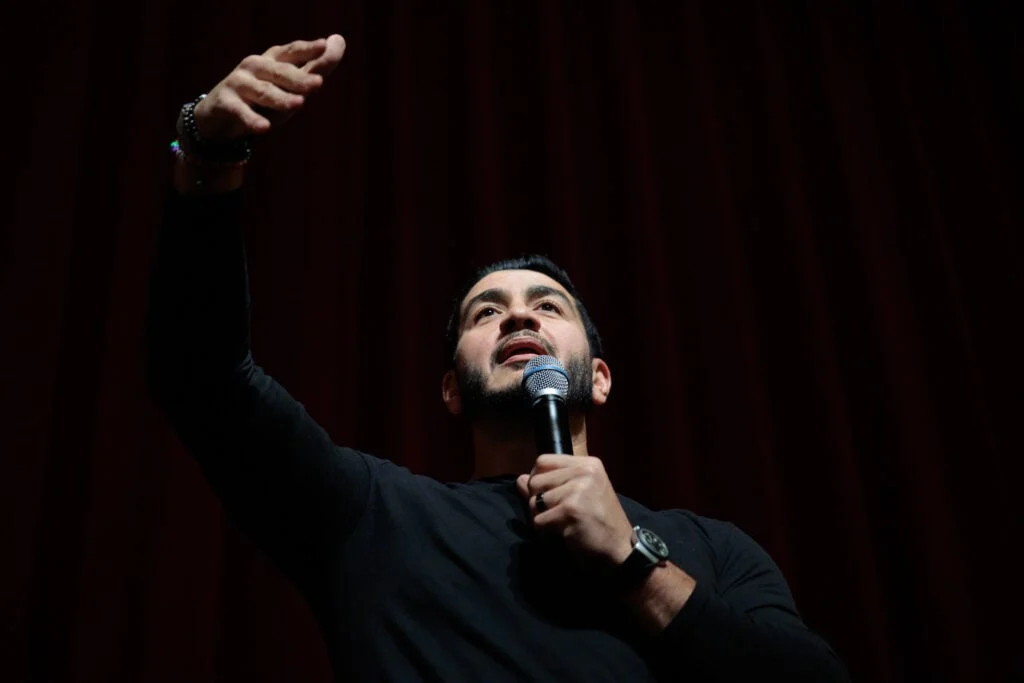
When a man identified as “Tommy” pressed Abdul El-Sayed at a town hall in Caro, Michigan, to disavow the Muslim Brotherhood, the Democratic Senate nominee answered without hesitation: yes.
It was a direct, unambiguous response to a loaded question, but El-Sayed did not stop there. He immediately turned the tables, challenging the very premise of the inquiry. He asked whether the man was assuming that, because he is a Muslim, he must inherently harbor “dual loyalties.” In the days that followed, as the exchange quickly went viral across social media and news broadcasts, local reports emerged revealing that the questioner, Tommy, was a former political staffer, adding a layer of calculated political theater to what was presented as a grassroots encounter.
Rather than shrinking from the provocation, El-Sayed used the moment to address a recurring undercurrent in American political life. “I’m not running to be a Muslim senator,” El-Sayed declared to the crowd. “I’m running for the U.S. Senate and happen to be Muslim.”
In making that distinction, El-Sayed was deliberately evoking one of the most famous moments in modern American political history: John F. Kennedy’s historic address to a room of skeptical Protestant clergy in Houston in September 1960. Back then, anxious ministers wanted to know whether a Catholic president would ultimately answer to Rome and the Pope. Kennedy met the challenge head-on, famously telling the audience, “I am not the Catholic candidate for president. I am the Democratic Party’s candidate for president, who happens also to be a Catholic.”
That historical parallel resonates deeply for many Americans who have watched religious minorities navigate the treacherous waters of national political ambition. The author of these reflections first encountered that Kennedy story as an eight-year-old child, sitting quietly in the back of a car while flipping through an illustrated book about the American presidents. When turning the page to John F. Kennedy, a father proudly piped up from the front seat, noting that Kennedy was the nation’s first Catholic president. Hearing the distinct joy and validation in his father’s voice, the young child asked why that milestone was so special.
In response, the father shared the very same story that El-Sayed recounted on the campaign trail in Michigan—the tale of a candidate who had to stand before his fellow citizens and personally assure them that his deeply held faith did not render him untrustworthy or un-American.
The father explained during that long-ago car ride that they lived in an America where too many neighbors looked at religious differences and saw a looming threat rather than something the country could collectively be proud of. When the child asked whether he thought another Catholic would ever be elected president again, the father sighed, took a thoughtful beat, and performed the quiet calculus every parent does when deciding whether to be entirely honest with a child about a hard, uncomfortable truth.
“Pray to Saint Jude,” the father said gently, invoking the patron saint of impossible causes. “That might be an impossible cause.”
Thirty years later, when Joe Biden was elected to the presidency, the author called the aging father, and they shared a laugh over the phone about the conversation from decades past. “Honestly, it’s a miracle,” the father said with genuine wonder. “Chalk one up for St. Jude.”
Memories like these serve as a vital tool, helping citizens recognize an old, familiar accusation when it returns wrapped in a new form. Speaking to reporters in Flint, Michigan, just a day after the tense town hall exchange, El-Sayed described the charge of dual loyalty as an attack with “a long history in our politics,” consistently aimed at people who “might pray a little bit differently.”
Kennedy made the exact same argument to those anxious ministers in Houston in 1960. He reminded them of their own shared history, pointing out that Virginia’s historical harassment of Baptist preachers had directly led to Thomas Jefferson drafting the foundational statute of religious freedom. Kennedy warned the ministers that while a Catholic might be the specific target of suspicion and religious anxiety that year, in other eras of American history, the target had been Jews, Quakers, and Baptists.
El-Sayed essentially asked the man in that Caro town hall to cultivate the same kind of historical memory that Kennedy had demanded of those Protestant ministers—a willingness to recognize that the religious freedom and pluralism so many take for granted today had been fought for and won by people whom their own forebears once deeply distrusted. Throughout the nation’s history, the commitment to religious liberty has been extended slowly and unevenly, frequently only after marginalized communities on the outside insisted repeatedly, and at great personal cost, that they belonged.
Remembering both parts of that complex history—the long, dark record of suspicion and the resilient record of Americans who kept pushing past it—is what prevents either narrative from passing for the whole story. Suspicion has predictably moved from one community to the next across the span of American history. Those whose families once lived under the heavy cloud of that suspicion have a particular calling to speak up when it lands on someone else, even if they share little in common, disagree on deeply important policy matters, or pray a little differently.
Standing together in defense of constitutional principles does not have to mean endorsing a candidate, nor does it require Michigan’s diverse Muslim, Jewish, and Christian communities to set aside the very real, painful disagreements that are currently straining their relationships. But it does mean flatly refusing the premise that an individual’s faith is inherently evidence against their love of country or their fundamental worth as a citizen.
El-Sayed told the man in Caro that the United States Constitution is “the guiding light” for him, and he asked his interlocutor to carefully consider why he was asking the question in the first place. What conclusions, El-Sayed challenged, had the questioner jumped to based solely on the lazy assumption that a differing creed means a citizen does not value their civic duty in the same way?
Yet, there is genuine encouragement to be found in how this story has played out before. When the author was eight years old, a father could not honestly say whether another Catholic would ever reach the Oval Office. By the time one finally did, the old, anxious question about whether a Catholic would answer to Rome had largely fallen away, relegated to the dustbin of political trivia.
History does not offer any absolute guarantees that the specific brand of suspicion El-Sayed faced on the campaign trail will fade in the exact same way, but it proves unequivocally that it can. That suspicion tends to fade fastest when people are finally willing to ask themselves the very hard question El-Sayed put to the man in Caro.
When someone’s faith makes others wary or uncomfortable, it is always worth pausing to ask what we actually know about that person as an individual. It is equally worth remembering that community after community, once asked to endlessly prove its loyalty to the American experiment, has gone on to help shape what patriotism and loyalty to this country truly look like.
Editor’s Note: On November 3, 2026, Democrat Abdul El-Sayed defeated Republican Mike Rogers in a closely watched campaign for Michigan’s Senate seat, making history by becoming the nation’s first Muslim senator.
