Through the Lens of Empathy: How "Interfaith Photovoice" Is Bridging Divides Across Campuses and Communities
In the immediate wake of the 2017 presidential inauguration, as a palpable tension settled over the political and cultural landscape of the United States, two friends sat down together for a quiet lunch. Before either of them could take a bite of their meal, the conversation naturally turned to the anxieties weighing heavily on their minds. They unpacked their deepest concerns regarding the shifting political climate, the rising tide of polarization, and the increasingly harsh public rhetoric targeting immigrants, marginalized groups, and people of color.
At the time, Roman Williams was a professor of sociology teaching alongside the Rev. Michael Bos at the Duke Divinity School. Sitting across from one another, they grappled with a fundamental question that many educators, faith leaders, and concerned citizens were asking themselves during that turbulent period.
“We asked, ‘What are a minister and a professor of sociology supposed to do at this moment?’” Williams recalled.
They recognized the limitations of their positions. They were not wealthy philanthropists, nor were they household names with the platform to command a national audience overnight. Yet, they shared an intense conviction that inaction was not an option.
“We emptied the lint out of our pockets,” Williams said. “We were not famous people or rich people, but we wanted to bring what we had to bear on this problem.”
Before their lunch plates had even been cleared, the outlines of a concrete plan began to take shape. They decided to leverage a tool that nearly every modern citizen carries in their pocket—the smartphone camera—to foster genuine relationships and build cross-cultural understanding between individuals who might otherwise never cross paths, let alone engage in meaningful dialogue.
They named their nascent initiative “Interfaith Photovoice.” The title was a deliberate nod to Photovoice, a well-established sociological research methodology developed in the 1990s. Traditional Photovoice invites participants to capture and share personal photographs as a means of granting them a voice and agency within their communities. Interfaith Photovoice adapts this core concept, deploying it specifically as a bridge between individuals hailing from diverse religious traditions, cultural backgrounds, and worldview perspectives.
“It’s the idea that contact across differences can create positive impacts on people,” Williams explained. “It changes them. They begin to ask questions of genuine curiosity; to see through the lens of other people and imagine ways their community might need to change so everyone can flourish, everyone can experience belonging.”
Years after that initial brainstorming session over lunch, the method has grown from a localized experiment into a dynamic, cross-border initiative. Recently, Williams demonstrated the power of Interfaith Photovoice at the Interfaith Leadership Summit in Chicago, an annual gathering organized by Interfaith America that brings together student leaders and student affairs professionals from colleges and universities across the United States.
During the demonstration, Williams asked each participant to share a personal photograph that exemplified their individual interpretation of hope. The instructions were simple yet profound: attendees showed their chosen images to their tablemates, articulating the personal meaning behind the snapshot. Once everyone at the table had shared their story, the floor opened up for organic questions, allowing participants to explore the deeper narratives hidden within each frame.
“A sense of unity”
Among those participating in the Chicago summit was Cameron Town, a 19-year-old Christian student attending the University of Northwestern, St. Paul. Town brought forward a striking snapshot capturing himself and his best friend mid-leap into the bracing, frigid waters of Lake Superior on a day weather-wise better suited for polar bears than recreational swimming.
“I chose this photo because all five friends I was with that day are some of my longest, most cherished friends, and yet many of us disagree on many levels about really important issues,” Town explained to the two women students with whom he was paired for the exercise. “At the end of the day—none of it changes the fact of our love and kinship for one another.”
When the session concluded, Town reflected on the emotional resonance of the exercise, noting that he felt “a surprising sense of unity” with his two partners, both of whom came from entirely different religious backgrounds.
“That sense of togetherness—despite being strangers—really left an impact on me,” he said.
That capacity to bridge profound divides has fueled the rapid expansion of Interfaith Photovoice since its formal launch in 2018. Backed by an initial grant, the earliest pilot sessions brought together Muslims and Christians in Richmond, Virginia; New Brunswick, Nova Scotia; and Grand Rapids, Michigan, where Williams was teaching as a professor at Calvin College.
“We learned a ton about the method, a ton about the experience,” Williams said. “By 2019, we realized we were on to something.”
When the COVID-19 pandemic disrupted in-person gatherings globally, the initiative adapted by migrating online. This pivot paradoxically allowed Williams to expand the scope of Interfaith Photovoice far beyond its initial Christian-Muslim framework, incorporating individuals from an extensive array of faiths, secular perspectives, and cultural backgrounds.
Today, the organization facilitates specialized workshops, intensive retreats, and collaborative team-building exercises for colleges, universities, corporate entities, and nonprofit organizations throughout the United States and Canada. Sessions have even reached as far internationally as Oman.
The photographs brought to the table by participants are wonderfully diverse, running the gamut from the lighthearted and goofy to the deeply reflective and majestic. In a single workshop, one might see a group of college friends posing alongside a Teenage Mutant Ninja Turtle costumed performer, followed immediately by a brilliant sunset casting golden light over an expansive forest, a quiet family dinner, or a beloved, lop-eared pet dog.
During the Chicago demonstration, Williams projected a seemingly mundane image of an Amazon delivery truck parked outside a suburban home, challenging the room to find deeper meaning within it. The single photograph yielded a dozen distinct interpretations from the audience. One participant saw the image as a symbol of happy anticipation, representing a long-awaited package and the excitement of gift-giving. Another found reassurance in a small “green vehicle” sticker affixed to the truck’s body, sparking a conversation about corporate sustainability. A third pointed out a striking reflection of sunlight glinting off the vehicle’s metallic rear bumper.
Crucially, darker and more complex social issues were not swept under the rug. Multiple participants immediately voiced concerns regarding the driver’s demanding working conditions, the systemic pressures of the gig economy, and the broader socioeconomic plight of low-wage workers.
This ability to transform everyday imagery into a canvas for nuanced, empathetic discourse is, according to organizers, the secret sauce of Interfaith Photovoice—harnessing the absolute ubiquity of personal smartphone photography and pairing it with an innate human desire to imbue personal experiences with shared meaning.
“An invitation to wonder”
“Interfaith Photovoice is an invitation to wonder,” said Kyle Kooyers, director of the Kaufman Interfaith Institute in Grand Rapids, Michigan. “It brings us into a place of inquisitiveness about the person across from us and that really does bring us into a profound place of human connections.”
In 2024, institutional support from a Kaufman Institute grant helped establish a semester-long Interfaith Photovoice workshop series at Grand Valley State University, a comprehensive public institution operating across multiple campuses in the Grand Rapids area. As part of a core exercise, a cohort of nine students representing Christian, Muslim, Hindu, Jewish, and secular backgrounds were tasked with capturing photographs that honestly expressed what it felt like to navigate their spiritual and ideological lives within the university environment.
“We got into questions of where they were experiencing barriers to expressing their faith or feeling like they belonged on campus or in their communities,” said Liz English, campus program manager for the university’s interfaith center. “Those were some wonderful sessions.”
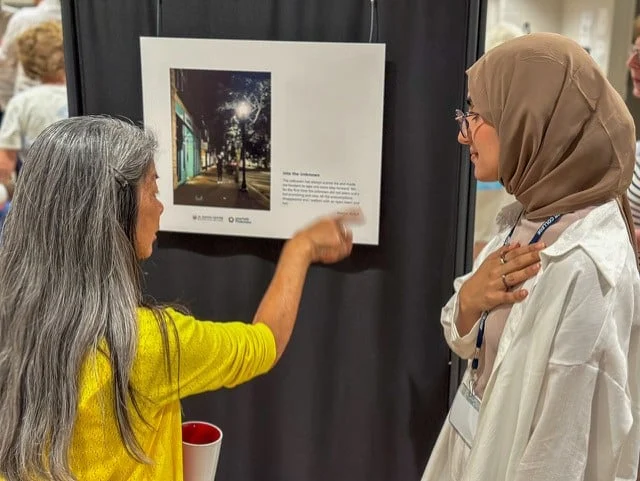
A parallel, semester-long Interfaith Photovoice program is currently active at the University of Maryland, Baltimore County. Much like the initiatives in Michigan and elsewhere, these structured programs culminate in public photography exhibitions. These showcases provide a vital platform where student creators can interact directly with the broader campus community, discussing their submitted photographs and the deeply personal stories that anchor them.
For Williams and his colleagues, the ultimate goal of these exhibitions is to deepen and enrich the practice of pluralism on college campuses in ways that traditional academic lectures, assigned textbooks, or the well-worn idiom about “walking a mile in another’s shoes” simply cannot achieve on their own.
“These days we need to learn to walk a mile in one another’s views so we can be prepared to live together in a community called university life,” Williams said. “That visual dimension opens a different side of us, and it allows us to think creatively and compassionately about ourselves and others so we aren’t just sitting in a circle and singing ‘Kumbaya.’”
