The Softer Side of Fire-Making
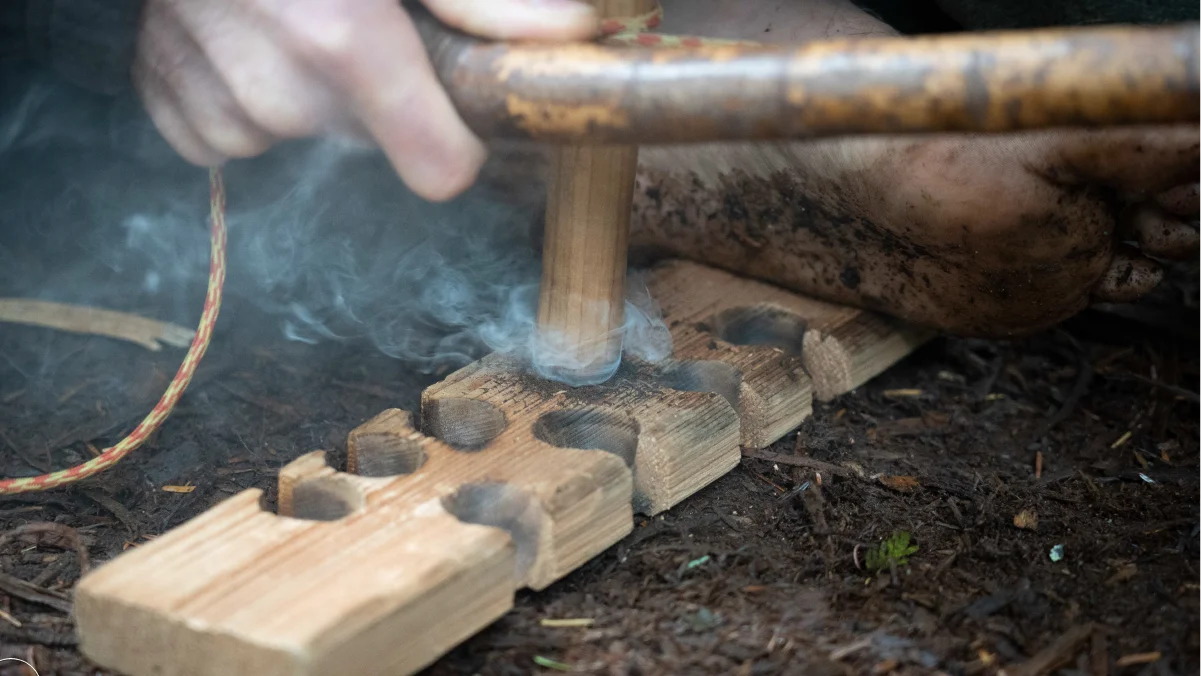
Wordlessly, Rivera moved in slow, dancer-like steps toward a piece of wood held steady
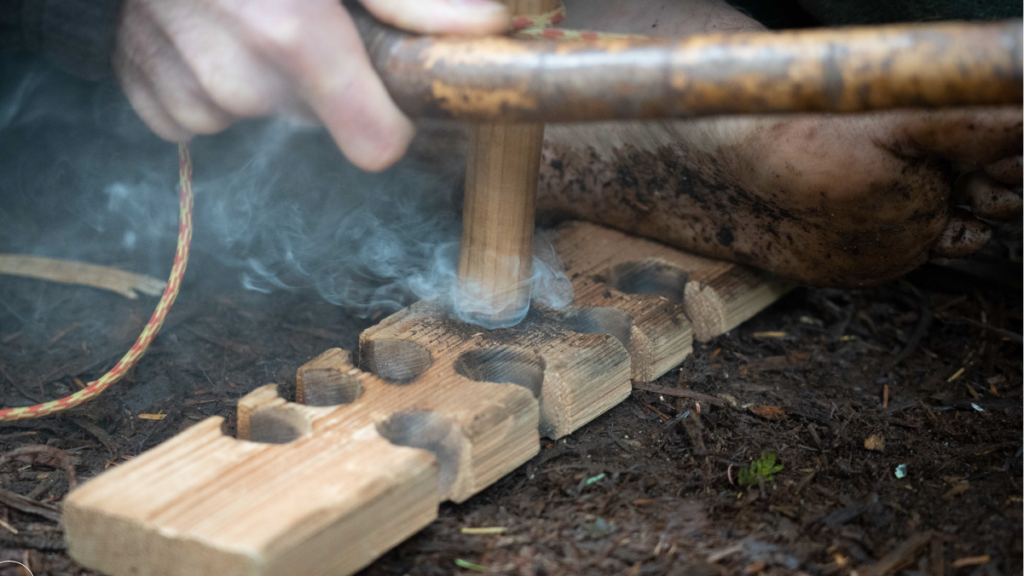
beneath one bare foot. Taking several deep, measured breaths, she closed her eyes, centering herself before beginning the physical labor of friction fire-making. With one hand, she pressed a wooden spindle downward into a board on the ground, while her other hand guided a handmade bow back and forth. The repetitive sawing motion generated friction between the spinning wood and the baseboard, accompanied only by the sound of her rhythmic breathing.
Before long, wisps of pale smoke began to rise from the drilled hole, signaling the formation of a fragile coal. Rivera carefully transferred this glowing ember into a soft tuft of shredded cedar tree bark. Kneeling beside it, she blew gentle, controlled breaths into the fibers until soft, golden flames erupted. She then transferred the nascent fire to a intricately carved "feather stick"—a piece of wood featuring thin, curled shavings designed to catch and hold a flame—before finally introducing it to the central fire pit.
The demonstration was brief; due to an active seasonal fire ban, the flames had to be extinguished almost immediately after they caught. Yet throughout the entire sequence, the roughly 50 attendees stood completely transfixed. Aside from the soft rustle of Rivera’s breathing and the eventual crackle of the wood, absolute silence hung over the gathering. For author and researcher Elizabeth Doerr, who attended the retreat as part of her ongoing exploration of modern preparedness, watching Rivera operate went far beyond the acquisition of a practical wilderness skill. It felt profoundly, undeniably spiritual.
Reflecting on the experience, Doerr acknowledged the slight hesitation she felt in applying spiritual terminology to an outdoor skills workshop. Such language can sometimes feel overly cliché within the context of a modern back-to-the-land movement. However, watching Rivera generate fire from seemingly raw elements while shutting out the attention of more than a hundred watching eyes revealed a deeper truth. It became clear that mastering fire-making requires far more than technical mechanics; it relies heavily on intuition, presence, and a profound attunement to the natural world.
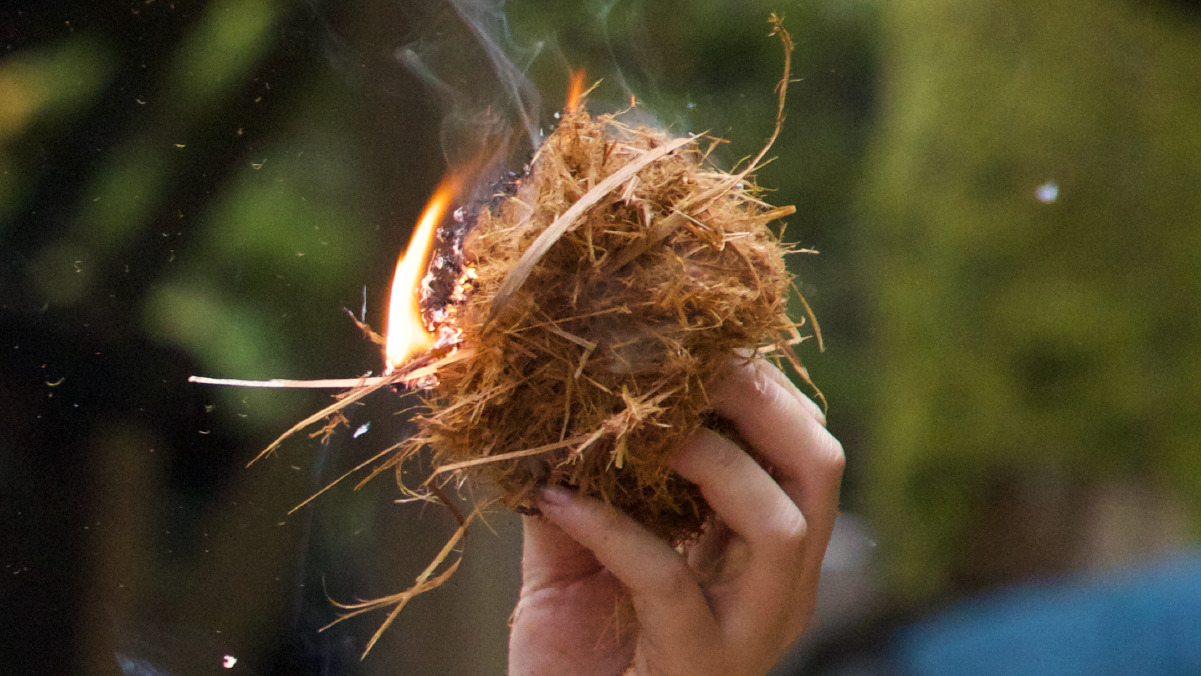
That realization was reinforced later when participants broke into smaller groups for hands-on workshops. Rivera led the fire-making session, introducing the attendees to the various tools used in primitive friction techniques, including bow drills, cedar bark, feather sticks, and kindling. As she laid out the equipment, anticipation rippled through the group at the prospect of finally learning how to coax fire from the surrounding landscape using nothing more than natural materials.
Then, Rivera delivered a perspective shift that fundamentally challenged conventional notions of wilderness survival. Explaining the use of modern survival gear, she noted that while carrying pre-made tools or artificial accelerants can be useful, they ultimately serve as a direct compensation for a person’s lack of familiarity and integration with their surrounding environment.
Reflecting on her own past camping trips—where she had struggled to ignite a primitive fire using a ferro rod and kindling before ultimately resorting to a disposable lighter out of sheer desperation to feed her family—Doerr absorbed the weight of Rivera’s philosophy. The long-term goal of truly knowing the land eliminates the absolute reliance on manufactured gear, though building that level of deep ecological literacy takes considerably longer than a weekend workshop.
As the session progressed into practical applications, Rivera demonstrated the rigorous preparation required before attempting to ignite a flame. The curriculum covered wood-chopping, fuel gathering, feather-stick creation, and standard fire-lighting techniques utilizing a ferro rod and a knife. Watching the meticulous steps unfold, Doerr noted a significant linguistic and philosophical distinction: Rivera consistently used the phrase "getting fire" rather than "making fire."
When questioned about the phrasing, Rivera explained that securing a flame demands emotional attunement alongside technical execution. In her view, fire is fundamentally ingrained in human physiology and history, serving not only as a physical center for community but as a reflection of human identity itself.
Approaching the task as "getting fire" implies that the flame already exists within the environment, waiting for the practitioner to become open and receptive to it. This perspective reframed the hard and soft skills of wilderness survival not as opposing categories, but as points on a continuous spectrum. While quantifiable, objective hard skills are built through time and physical labor—such as gathering the correct type of bark, striking a ferro rod at the precise angle, or processing wood into properly sized kindling—they offer no absolute guarantee of success. Reaching the threshold of ignition requires qualitative, subjective soft skills like patience, critical thinking, and heightened situational awareness.
By the conclusion of the workshop, Doerr successfully navigated the physical components of the challenge. She processed wood, crafted functional if imperfect feather sticks, scraped the inner lining of a cedar bark plank to harvest tinder, and used a ferro rod to generate a spark that caught a small piece of charred denim. Gently nursing the spark with breath, she transferred it to the cedar tuft and established a working flame in the pit.
However, the limits of this newly acquired mindset were tested during a timed evaluation requiring participants to start a fire using a single match within five minutes. Under the pressure of the clock, Doerr’s heart raced, frustration set in, and her attempt failed. Staring at the unlit tinder, she questioned her capability to handle emergency scenarios.
Recalling Rivera’s earlier guidance provided a crucial perspective shift. Rivera had previously emphasized that remaining calm and failing to produce a flame is preferable to panicking and accidentally forcing a dangerous situation. Furthermore, she had advised students to invite the fire rather than force it. Doerr realized that under the pressure of the timed test, she had attempted to force the outcome rather than cultivate the necessary mental space to receive the fire. The failure, paired with Rivera’s teachings, underscored that technical execution alone is insufficient without psychological composure.
This integration of mindfulness and technical training defined the overarching ethos of the Wild Women’s Weekend. The curriculum structured by the Wilderness Awareness School carefully balanced softer, mindfulness-oriented nature sessions with harder, skill-based workshops in fire-building and plant identification. Yet even the most technical subjects demanded a foundational awareness of nature and self that leaned heavily into the intuitive end of the spectrum.
For Doerr, whose research into survivalism often distanced itself from the hyper-masculine, rigidly technical focus of traditional prepper communities, the approach offered a welcome alternative. The Wilderness Awareness School model provides a framework of grace, acknowledging that individuals progress along a diverse spectrum of learning without chasing an impossible standard of ultimate mastery. Instead of a competitive race, survival skill development emerges as a lifelong cultivation of intuition—a capability that, combined with foundational knowledge, forms an essential key to navigating the uncertainties of the future.
