Old Navy Pulls Festive Hanukkah Pajamas From Canadian Stores Following Bizarre Holiday Merch Blunder
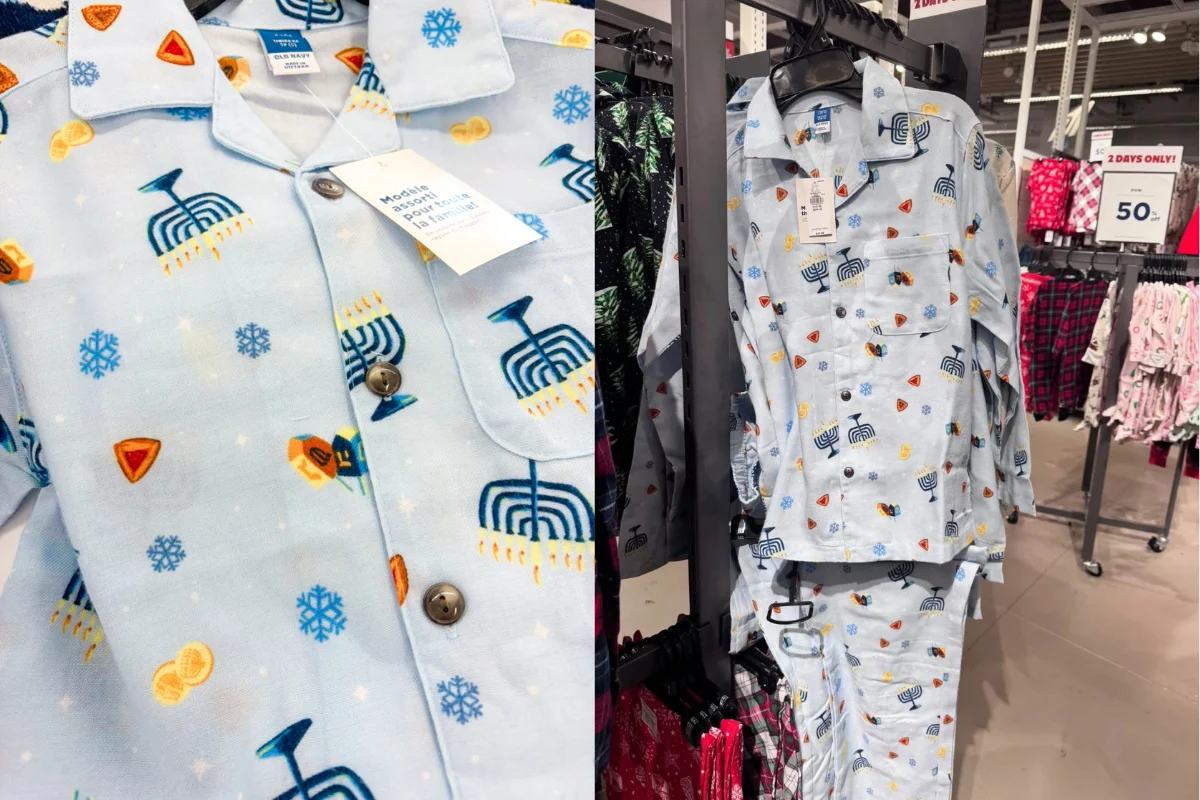
The holiday merchandising season is an annual minefield of cultural oversights, mistranslated alphabets, and misplaced festive symbols, but this year’s retail landscape has officially produced what experts are calling a true holiday classic of manufacturing mishaps. For Rabbi Yael Buechler, a lower school rabbi and outreach coordinator who has spent years chronicling the strange and often humorous world of American Hanukkah merchandise, she believed she had seen it all. From doves and challah to Torah scrolls and three-pronged menorahs, the expanding universe of Jewish-themed seasonal loungewear rarely failed to amuse her. That was until earlier this month, when photos began surfacing of Old Navy’s newest Hanukkah pajamas, featuring a print that included the usual collection of winter icons alongside a rather unexpected guest: hamantaschen.
The triangular, fruit-filled pastries traditionally associated with the spring holiday of Purim had somehow found their way onto winter sleepwear designed specifically for the Festival of Lights. While the inclusion of a pastry typically baked to commemorate the defeat of Haman raised eyebrows among observant shoppers, the rollout took an even stranger turn. For weeks, the festive loungewear was mysteriously turning up exclusively in Canadian Old Navy stores. American shoppers and eager collectors were left wondering how to orchestrate cross-border acquisitions for a pair of pajamas decorated with misplaced Purim treats, but the regional exclusivity proved to be short-lived.

Just as curious consumers were trying to figure out how to import a pair across the border, the plot thickened considerably. Canadian retail locations reportedly received urgent corporate directives—including a notice as recently as October 21—ordering store managers to immediately scrub the pajamas from the sales floor and ship them back to distribution centers. Staff members were not merely instructed to hide the inventory in the stockroom out of sight; they were commanded to banish the items from the premises entirely.
Old Navy has not responded to multiple requests for comment regarding the sudden and dramatic disappearance of the Hanukkah pajamas. While the retail giant has not officially slapped a traditional "recall" label on the incident, retail industry insiders familiar with such matters note that sudden and sweeping removals of this nature typically stem from significant product defects or unexpected licensing and design issues. Whether misplaced pastries qualify as a manufacturing defect remains a subject of amusement for those following the story. Buechler noted that she is personally familiar with hamantaschen defects, observing that most of the batches she bakes at home tend to burst open in the oven despite aggressive corner-pinching.
Of course, Old Navy is hardly alone in navigating the booming, yet frequently error-prone, industry of holiday Jewish loungewear. Buechler’s ten-year-old son has even coined a specific term for these recurring merchandising blunders: the "Hanukkahtastrophe." This particular holiday season has proven to be especially rich in such errors across multiple major brands, highlighting a persistent disconnect in the mass production of culturally specific seasonal goods.

Other notable entries into this year’s catalog of errors include Caden Lane, which recently released a line of Hanukkah pajamas sporting jumbled Hebrew text, random illustrations of challah bread, and an inexplicable Christmas tree, despite the items not being marketed as multifaith apparel. Similarly, Burt’s Bees Baby stamped their traditional dreidel patterns with a mysterious symbol closely resembling the Hebrew letter chet, a character that famously does not appear on a standard dreidel, which features the letters nun, gimel, hey, and shin. Meanwhile, Pixie Lane went entirely rogue with a collection featuring nonsensical, artificial intelligence-generated characters that bore little resemblance to any traditional holiday motifs.
Even Old Navy is a repeat offender when it comes to these seasonal oversights. The company’s 2024 Hanukkah collection notably included dreidels featuring backwards Hebrew lettering, demonstrating a recurring challenge in quality control for culturally themed holiday prints.
To be fair, the inclusion of various Jewish foods in modern lifestyle merchandise is not entirely unprecedented when handled with broader culinary context. West Elm, for instance, previously released a popular line of appetizer plates featuring an assortment of traditional Jewish bakery items, including a black-and-white cookie, a piece of rugelach, a jelly donut, and hamantaschen. However, retail observers point out that celebrating a broad assortment of Jewish culinary heritage on a decorative serving dish is vastly different from placing Purim treats onto sleepwear specifically designated for the wintertime Festival of Lights.

Despite missing out on the opportunity to add the elusive pajamas to her growing archive—a collection that currently occupies an entire plastic storage tub in her home—Buechler expressed a degree of appreciation for Old Navy’s swift and decisive intervention. Having watched numerous major brands leave completely scrambled Hebrew characters and glaring design errors on store shelves for weeks after internet users pointed out their blunders, she views the rapid corporate purge as a refreshing change of pace.
Whether the rogue hamantaschen served as the true catalyst for Old Navy’s sweeping decision remains a corporate mystery, locked away within retail supply chain logistics. Whatever ultimately triggered the sudden removal, the prompt action stands out as a minor holiday miracle for those who advocate for greater accuracy in cultural merchandising. Industry observers and consumers alike are left hoping that more retail companies will begin catching these design gaffes during the early stages of production before the items ever make it to the retail racks.
For the record, if any shoppers in Canada managed to successfully snag a pair of the elusive pajamas before they vanished entirely into the retail abyss, there is at least one enthusiastic collector who would still love to get her hands on them. As she noted with a touch of seasonal humor, she is more than prepared to wear them when spring arrives and Purim finally rolls around.
