How Revisiting *Anne of Green G
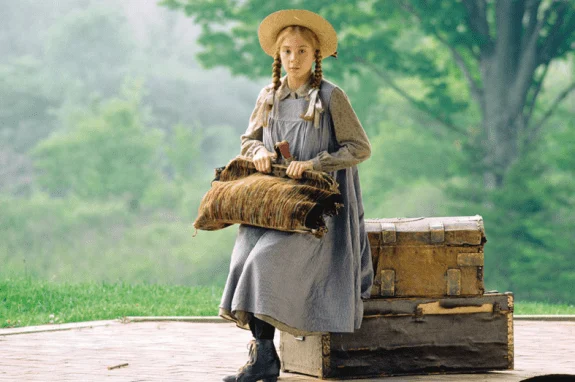
ables* Helped One Mother Chill Out and Trust the Power of Maturation
By Jamie C. Martin, Editor of Simple Homeschool
“There, there, Marilla, you can have your own way,” said Matthew reassuringly. “Only be as good and kind to her as you can without spoiling her. I kind of think she’s one of the sort you can do anything with if you only get her to love you.”
For many readers, the journey into childhood imagination begins and ends with a spirited, red-headed orphan from Prince Edward Island. As a 12-year-old, spending hours under the influence of Lucy Maud Montgomery’s most famous creation changed everything. There were exciting adventures shared, valuable life lessons absorbed, and foundational seeds planted that would later grow into a full harvest—seeds of adoption, a lifelong love for literature, a passion for writing, and the unapologetic mindset of a starry-eyed dreamer.

That early literary impact shaped years of reading. The entire Anne of Green Gables series was devoured multiple times throughout adolescence and young adulthood, alongside nearly every other title penned by L.M. Montgomery. The author’s unique voice simply spoke to a developing mind.
Years later, as a newly married woman, that literary bond deepened profoundly upon discovering all five volumes of L.M. Montgomery’s personal journals. For serious fans of the author, these intimate records offer a stark window into her reality. Once again, Montgomery’s written words altered a reader’s perspective, though this time the experience was far less starry-eyed. These grown-up entries revealed a complex tapestry of profound joy mixed with deep sorrow, happiness existing side-by-side with heartbreak. It became challenging to ever look at the cheerful world of Green Gables in quite the same light again.
Yet, as it turned out, Anne Shirley still had a few more lessons tucked away in her famously puffed sleeves.
Finding a New Perspective Through Parenting
Literary critics often suggest that when revisiting a classic novel—particularly one that has impacted generations of readers—approaching the text with a specific, personal question in mind can yield entirely new insights. When picking up Anne of Green Gables years later as the parent of three children, a single, guiding question emerged: What can a modern parent actually learn about raising children from this timeless nineteenth-century story?

The surprising answer uncovered in those pages is a philosophy that has guided daily family life ever since: loosen up and let maturity do its work.
During her tween and early teen years, Anne is a whirlwind of constant mischief. She invents elaborate tall tales, accidentally dyes her hair an unfortunate shade of bright green, tumbles off the ridgepole of a barn roof, and inadvertently gets her dearest bosom friend, Diana Barry, deeply intoxicated on raspberry cordial—to name just a few of her misadventures. For parents navigating the daily trials of raising lively children, these scenarios strike a remarkably familiar chord.
Furthermore, Anne possesses a fierce, unbridled temper. This volatile emotion reaches its dramatic peak when she shatters a slate clean over the head of her classmate, Gilbert Blythe, after he publicly taunts her about her red hair. Even when Gilbert attempts a remorseful reconciliation, Anne demonstrates a stubborn, unyielding tendency to hold a grudge.
In one memorable passage from the novel, Gilbert attempts a peace offering: "Gilbert took from his desk a little pink candy heart with a gold motto on it, ‘You are sweet,’ and slipped it under the curve of Anne’s arm. Whereupon Anne arose, took the pink heart gingerly between the tips of her fingers, dropped it on the floor, ground it to powder beneath her heel, and resumed her position without deigning to bestow a glance on Gilbert."

The Wisdom of Marilla Cuthbert
Facing such fiery behavior, tense and stern Marilla Cuthbert—who, alongside her gentle brother Matthew, originally adopted Anne—gradually softens. Rather than crushing the child’s spirit through rigid punishment, Marilla responds with remarkable patience. Following the broken slate incident, Marilla takes the practical advice of neighbor Rachel Lynde and permits Anne to stay home from school for an extended period, effectively homeschooling her until the girl decides of her own accord that she is ready to return.
“Marilla took Mrs. Rachel’s advice and not another word was said to Anne about going back to school,” the text notes. “She learned her lessons at home, did her chores and played with Diana in the chilly purple autumn twilights…”
Beneath all of Anne’s mischief, rule-breaking, and emotional outbursts, a profound genius was quietly at work: boundless imagination, fierce creativity, keen intelligence, and deep character. These traits simply required time, patience, and space to find their proper expression. At the right season in her life, that chaotic energy blossomed into true brilliance.
Reflecting on Anne’s gradual maturation process brings to mind observations from contemporary educational literature, such as the insights found in Unschooling Rules: 55 Ways to Unlearn What We Know About School and Rediscover Education. As noted in the book’s chapter on maturation solving many problems:

“The truth here is that maturation is magic. Irrational teenagers do become rational. Calmness and focus return. All of childhood is filled with times of equilibrium and disequilibrium. Children’s bodies do each have their own clock. Each clock just may not match the expectations of the structures around the children.”
Trusting the Educational Process
For parents and educators navigating the demands of homeschooling or everyday child-rearing, it is easy to become overly tense, strict, and micromanaging. But what would happen if adults trusted the natural process of maturity to do its vital work?
Perhaps, by trusting the process, caregivers could relax a little more, find humor in the midst of daily mischief, and truly allow themselves to enjoy the unpredictable journey of raising children. As L.M. Montgomery’s timeless work subtly reminds us, a little appreciation and grace sometimes accomplishes just as much good as all the heavily conscientious bringing-up in the world.
