Generational Trauma, the Mind-Gut Connection, and One Author’s Lifelong Journey to Break the Cycle of Anxiety
By Judy Batalion
Some of my earliest memories are rooted in the sudden, gripping sensations of panic attacks. When I was just 3 years old, my family often went browsing at Bonimart, a discount department store featuring a bubbly orange logo. While other children might have focused on the toys or the brightly colored displays, my heart pounded with a fierce, paralyzing terror that we would be locked inside the building forever. Later, at day camp, an extreme, visceral fear of water meant I spent my time doggie-paddling dry on the concrete deck, unable to bring myself to step into the pool. By the time I reached kindergarten, petrified of being abandoned, I suffered daily tummy cramps before dismissal, consumed by the terrifying imagination that I would be stranded, alone, forever.
My father tried to help me navigate these overwhelming waves of fear. He attempted to explain the fundamental difference between possible versus probable outcomes. Outside the doors of Bonimart, he even developed a gradual, methodical 12-step program to help me acclimate. Each week, holding tightly to his hand, I would take one more step inside the building, slowly teaching my nervous system that the threat was an illusion. There was nothing to truly fear, I eventually understood, aside from fear disorders themselves.
Yet, I was not merely an isolated case or the trembling black sheep of my family; anxiety felt baked directly into my bones. I come from a lineage of Holocaust survivors, meaning that worry literally saved my genetic line. My bubbe had sniffed out the danger with an instinct honed by impending catastrophe. Soon after the Nazis occupied Warsaw, she overheard her neighbors reporting on who was Jewish. She knew instantly that it was time to run, right then and there. Her parents and sisters, who chose to stay behind, were tragically killed.
That profound, foundational trauma trickled directly through our bloodline. It became the framework of how we lived: perpetually on high alert. Stress, as my family history demonstrated, has its evolutionary benefits, and we hung onto it, clutching it for dear life as a mechanism of survival. Years later, my college roommates would crack up at the frantic urgency of my mother’s answering machine messages, which warned of perils such as sitting at the back of the plane, the dangers of cuticle cutting causing botulism, and making absolutely sure that lip gloss contained no petroleum.
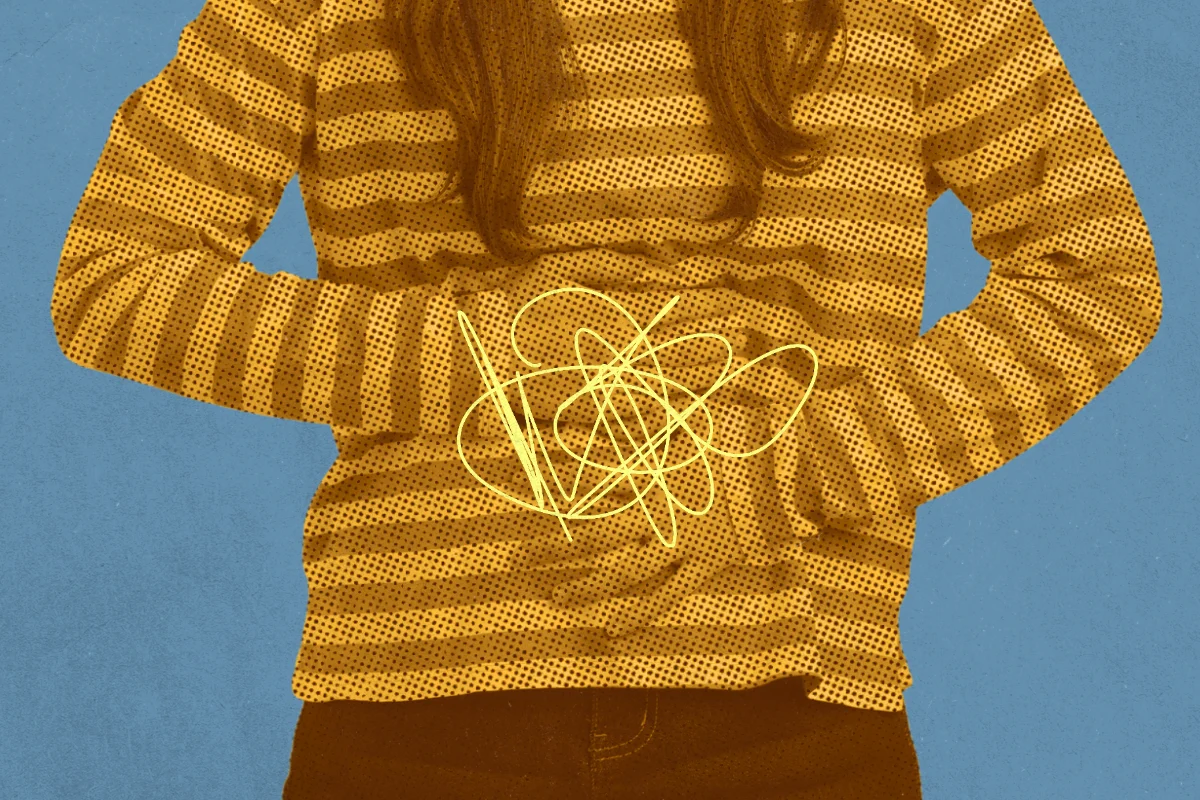
Given this background, it was perhaps unsurprising when, at the age of 12, I developed a severe stomach condition during my very first trip to New York City. Standing at the Statue of Liberty, I looked out onto the bustling horizon of possibility and suddenly became overwhelmingly nauseous. That night, running a fever, I began vomiting and making endless trips to the toilet. Though that acute illness eventually abated, my digestive symptoms lingered, casting a long shadow over my adolescent years. Eventually, I received a formal diagnosis: ulcerative colitis.
This raised a persistent question in my mind and among those caring for me: Was this merely a "nervous stomach"?
Medical science has long wrestled with the precise causes of colitis. For decades, it was frequently considered psychosomatic, incorrectly believed to affect primarily those with a neurotic psychological profile. By the 1990s, however, autoimmune theories came firmly into vogue. My doctors stressed repeatedly that ulcerative colitis was not caused by stress, but part of me never quite bought the absolute separation of mind and body.
Currently, modern medical explanations often point toward the complex, two-way mind-gut connection. Remarkably, ninety percent of the serotonin, the hormone that regulates mood, is produced directly in the gastrointestinal tract. In this bidirectional pathway, stress triggers gastrointestinal symptoms, while gut inflammation simultaneously releases chemical signals that trigger psychological stress. It is a closed, exhausting loop.
Eventually, with the help of heavy doses of steroids, my condition went into remission. That stability held until my grandfather, my Zaidy, passed away. The profound grief triggered an immediate and severe colitis flare, and the medications that had once worked for me suddenly became completely ineffective. As my health deteriorated, doctors began to worry about the escalating risk of cancer. Faced with no other viable medical option, they ultimately made the decision to remove my entire colon.
The painful organ was surgically amputated, and remarkably, I felt better. Thank God, the constant physical agony was gone.
My anxiety, however, was not so neatly or easily excised by a surgeon’s scalpel. Sure, at social gatherings, I could now leave the restroom without physical urgency—but the underlying psychological distress remained, because anxiety abhors a vacuum. The doors of Bonimart were replaced by new triggers: turbulence during flights, heights, and eventually, a severe form of "health anxiety," characterized by ultra-sensitive bodily fear alarms.
Those of us who experience nosophobia are hyperaware of every internal sensation, stubbornly convinced that any minor physical symptom is the herald of a life-threatening disease. I panicked uncontrollably before routine doctor visits and frequently fainted if a lab test result came back even a smidgen out of bounds. I was entirely sure that cancer was coming for me next, even after my colon had been removed. I reasoned that I had to remain vigilant; after all, that was how my family had always survived.
I knew intellectually that these obsessive thoughts seemed absurd, and so I kept my fears a closely guarded secret. Then, one day, during a routine family trip to a midtown CVS for flu shots, the reality of my condition collided with my parenting. My otherwise ultra-mature, graceful fourth-grader suddenly went berserk, hysterically rampaging through the drugstore in a panic. My husband and I actually had to hold her down to keep her safe.
In that chaotic moment, I understood a sobering truth: despite my best attempts to bottle it up, my anxiety was unintentionally passing down to my children. They did not feel safe in the world.
"I get it," I told her later, trying to soothe her lingering tears. "I once fainted trying to put in contact lenses."
"Why wouldn’t I be scared?" she countered sharply. "A stranger with a bad haircut in a dingy drugstore was going to painfully poke through my skin with a needle!"
She was entirely right. Her reaction was logical within the framework of her immediate sensory experience. The realization forced me to reevaluate my approach: How could I possibly teach her, and by extension myself, to be alert without falling into outright panic? How could we learn to acknowledge a genuine threat, calmly assess it, and act appropriately without letting terror dictate our lives? And hovering in the background was a lingering maternal fear: What if she develops colitis, too? Another terrifying possibility to worry about.
I knew I had to change. I began reading extensively about trauma and sought out professional therapies designed to rewire these deep-seated responses. I actively worked to reverse my internal narrative, shifting the perspective from one of inherited weakness to one of profound resilience. My family is so strong that we survived the Holocaust, I reminded myself. I have experienced the excruciating sensation of what felt like glass shards jetting through my sphincter as I chased toddlers around the Coney Island aquarium, and yet I am still going strong.
I even tried reframing things for my daughter, telling her that her body is so smart it recognizes a faux virus and immediately creates antibodies to protect her. She characteristically rolled her eyes at my therapeutic optimism.
Of course, these cognitive realizations have not miraculously halted my doom spirals or completely alleviated all my visceral sensations of unease. Seeing the inherent vulnerability of my young children reminded me sharply of my own youthful helplessness. I finally understood that I must confront my childhood feelings of trepidation and the deep-seated anger I held toward my illness—feelings I had long repressed in my desperate attempt to simply move on. I realized I had to confront the fear caused by an illness that was, in part, fueled by fear itself.
Today, I am actively trying to tackle my formative dreads. I may no longer be standing outside Bonimart having worst-case-scenario heart palpitations, but I am still working my way through my father’s metaphorical 12 steps. More than anything, I am profoundly hopeful that I will not need to create that same coping program for my own children. My bubbe’s vigilance kept her safe in a dark and dangerous time, but I pray that the passing down of crippling, generational anxiety ends right here with me.
