Tracing Infinity: How Jewish Artist Benjamin Sack Turned Global Voyage Into a Canvas
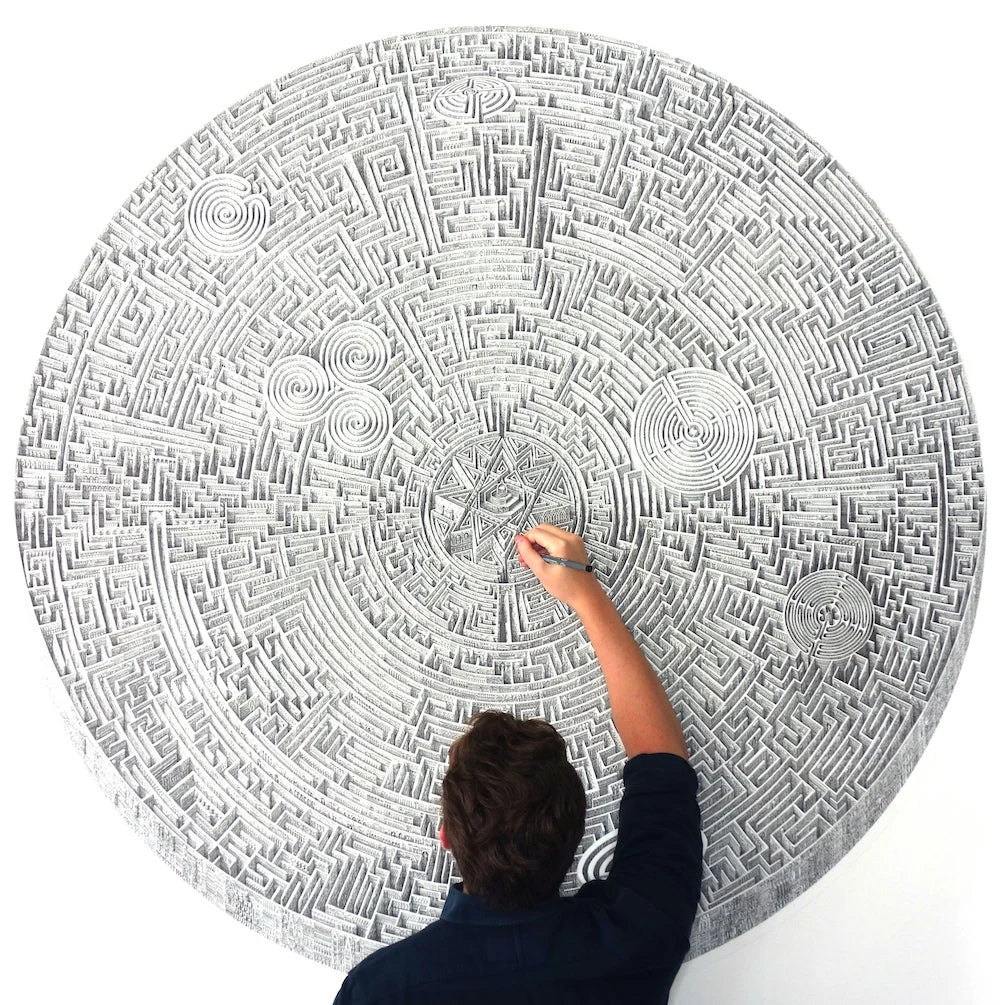
For centuries, Jewish history has been defined by movement, displacement, and the relentless pursuit of new horizons across an unfamiliar earth. It is a legacy that resonates deeply with contemporary artist Benjamin Sack, who has spent much of the past decade transforming that ancestral motif of the wanderer into an astonishing visual practice. Specializing in intricate, meticulously detailed drawings of imagined cities, cosmic labyrinths, and sprawling cartographic projections, Sack has effectively mapped his own nomadic existence onto paper.
"We’ve been a wandering people, generally, for most of our history. And that’s what I’ve become: the proverbial wandering Jew," Sack reflects.
Sack’s distinctive artistic vision is heavily influenced by a confluence of historical cartography, symphonic orchestration, architectural drawing, and an extraordinary level of personal travel. Over the course of his career, he has circumnavigated the globe eight times, serving as an artist-in-residence aboard cruise ships embarking on epic, around-the-world voyages. For an artist whose childhood was spent sketching maps inspired by classic fantasy literature like The Lord of the Rings and The Chronicles of Narnia, finding himself sketching the actual contours of the planet from the deck of a ship feels like a surreal alignment of destiny.
"As a child, I drew maps — I loved and drew Lord of the Rings and The Chronicles of Narnia, and maps are a major part of those stories — and then I ended up circling the world eight times on a ship, creating my own large works and maps, or projections, of the world," Sack notes, describing the full-circle nature of his passions as both beautiful and uncanny.

Yet, these transformative sea voyages were not simply handed to the artist; they are the direct result of sheer ambition and proactive outreach. After graduating with a Bachelor of Fine Arts from Virginia Commonwealth University in 2011, Sack found himself yearning for a broader perspective on the world he loved to recreate on paper. While books and the internet offered a wealth of visual information, he recognized that true artistic growth required firsthand experience. Eager to travel but lacking the financial means to fund a global excursion independently, he set out to forge his own path.
Inspiration struck when he encountered an advertisement for a "Grand World Voyage" offered by the Holland America cruise line aboard a vessel named the Amsterdam. The ship’s onboard aesthetic drew heavily from the Dutch Golden Age, a historical period celebrated for producing some of the world’s most accomplished mapmakers. Growing up studying and drawing from those very same Dutch masters, Sack felt an immediate spiritual connection to the venture.
Demonstrating notable initiative despite having zero prior experience as an artist-in-residence, Sack reached out directly to the cruise line. He pitched a simple yet mutually beneficial arrangement: in exchange for a dedicated cabin to live and work in, he would offer drawing classes to passengers and create a monumental, original artwork to commemorate the voyage. Within weeks, Holland America responded with enthusiasm, setting the stage for a life-altering chapter.
In 2014, Sack boarded the ship for his inaugural Grand World Voyage. The 114-day itinerary spanned five continents and brought the vessel to 38 distinct ports, including such remote and diverse destinations as Easter Island, Papua New Guinea, Hong Kong, Sri Lanka, and Cape Town. When asked if the experience was eye-opening, Sack’s response is immediate and emphatic: "Third, fourth, and fifth-eye opening."
Since that initial journey, Sack has participated in a world voyage nearly every year, pausing only during the disruptions of the COVID-19 pandemic, alongside shorter artistic stints on other vessels. This nomadic rhythm has profoundly shaped the evolution of his style. While his early works sought to echo the precise projections of Dutch masters overlaid with modest details from visited ports, his aesthetic has steadily matured into something entirely distinct. Today, his pieces invite the viewer’s eye to wander through an immersive, labyrinthine journey where structure and imagination seamlessly merge.

Balancing his time between New York and Virginia when on land, Sack is represented commercially by the Robert Fontaine Gallery in Miami and Galeria Ethra in Mexico City. Despite the international acclaim and gallery representation, the fundamental mechanics of his creative process remain remarkably portable. When asked how one manages to produce large-scale drawings while residing in a compact ship cabin, Sack explains that the living quarters temporarily double as a functioning studio.
"They give me a studio — it’s my cabin as well. I ask them to take down the hooks, hangers, and artwork on the wall, and then it’s a big wall where I hang my work-in-progress," Sack explains. "That’s what I love about my art: I can take it anywhere. That’s the point. Pen, paper. The infrastructure of my cities — ink on a two-dimensional plane — is very simple, but you can take it anywhere."
This portability mirrors his broader artistic philosophy, which draws deep inspiration not only from his physical travels but also from literary and musical giants. Among his enduring inspirations is the 18th-century mystic poet William Blake, whose renowned poem Auguries of Innocence famously begins with the lines: "To see a World in a Grain of Sand / And a Heaven in a Wild Flower / Hold Infinity in the palm of your hand / And Eternity in an hour."
Sack finds a similar boundless scope in the work of Jewish composer Gustav Mahler, whose famous assertion that "a symphony should be like the world; it should contain everything" resonates deeply with the artist’s own visual ambitions. For Sack, these artistic touchstones reinforce the idea that miniature details can reveal vast universes, evoking a profound sense of wonder.
That sense of wonder and expansive exploration is inextricably linked to Sack’s Jewish identity, which informs his relationship with the world around him. Drawing a parallel to the foundational biblical narrative of Abraham answering a divine call to venture outward into the unknown, Sack views his creative output as an act of engagement and stewardship.

"You know, Abraham, before the whole story began, he heard God — or, you know, the voice, the spirit, the compulsion — to ‘go out.’ That’s my answer in its simplest form. With my work, there’s this sense of not just going into the world, but capturing the world," Sack reflects.
Viewing drawing as a philosophical dialogue with existence, Sack sees the artistic process as a direct contribution to creation itself. In a universe perceived as a mere speck of dust, the act of bringing intricate worlds to life on a blank page serves as an ongoing meditation.
"Fundamentally, drawing anything is Genesis. You know, ‘In the beginning,’" he notes.
Benjamin Sack’s work continues to be showcased to audiences through exhibitions and public programming, including virtual artist spotlight events exploring the realities of working as a Jewish artist today. Through every stroke of ink and every imagined skyline, Sack carries forward a timeless tradition of mapping the infinite.
